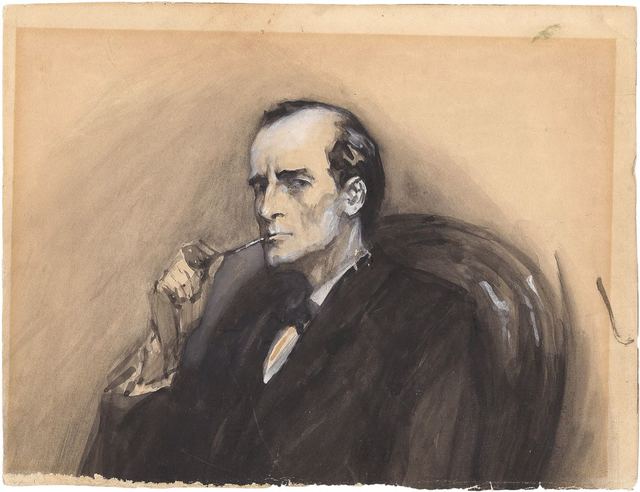
Sherlock Holmes: In the Shoes of a Consulting Detective
1891 · Tracing the Path of a Man Who Never Was
A city created the haunts of an imaginary man. 221B wasn't there when he was invented — the street had to be extended. A bank employed someone full-time, for fifty years, just to reply to his letters. Here is the real investigation.
16 min of listening
The route
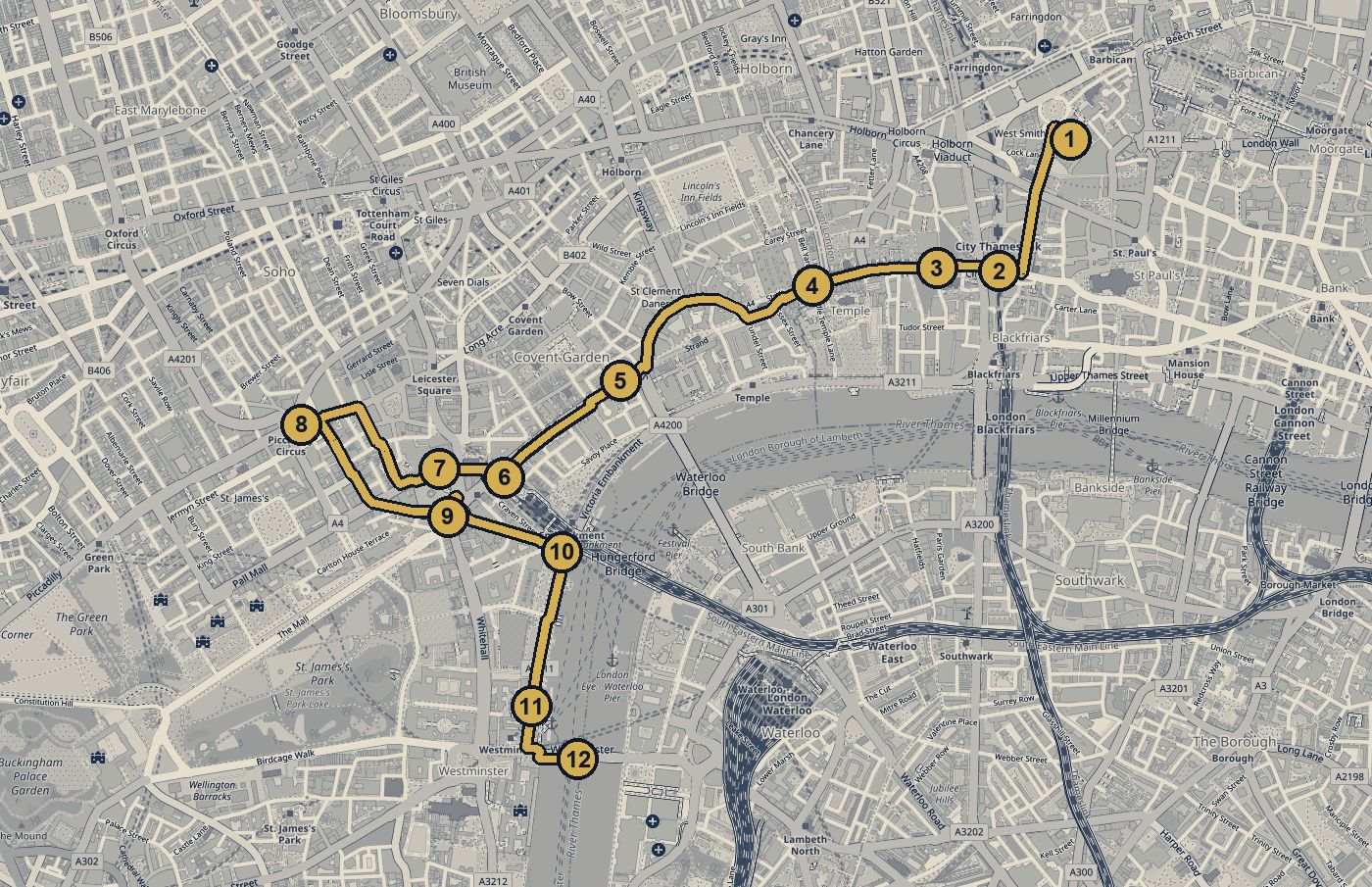
5.5 km on foot · See the starting point on a map · © OpenStreetMap
The stops
-
I Have Never Existed 1:27
Read the text
Let's begin with the one unassailable fact of this tale.
We are in April 1891.
I have never existed.
There it is. Said and done. It's better this way. A conclusion drawn from a false premise leads somewhere, but never where it ought.
I was born in 1887, in a magazine, crafted by the pen of a thirty-one-year-old doctor who had no patients. Bored in his Portsmouth practice, he turned to writing. He modelled me after one of his medical professors in Edinburgh, a man who could deduce a patient's occupation from their hands and their route from the mud on their shoes.
This doctor, today, despises me. Finds me burdensome. He longs to write historical novels, but the public demands only me. This year, he plans to kill me: I'll fall from a waterfall in Switzerland, locked in combat with my nemesis.
Readers will don black armbands in the streets of this city. Twenty thousand will cancel their subscriptions. He'll be forced to resurrect me eight years later, claiming I clung to a rock.
Now, walk. We're about to do something rather peculiar: traverse the real locations of a life that never happened.
You'll see, the city has adapted.
-
Saint Bartholomew’s, the Meeting 1:25
Read the text
It is here that Watson steps into my life, and here that I make my only true methodological error.
I am in the chemistry lab, downstairs. I have just discovered a reagent that precipitates with haemoglobin and nothing else — a method to identify an old bloodstain, something no one else can do. I am in excellent spirits.
A friend brings me a man in search of a flatmate. I shake his hand and say: I see you have been in Afghanistan.
He is speechless, which was the intention.
It wasn't magic, though. A man with a medical air but tanned like a soldier; the wrist pale, so the tan is from the sun, not his skin; he holds his left arm stiffly; he looks exhausted. A military doctor back from a hot country where there is fighting and injuries. In 1881, that is Afghanistan.
Here is the methodological error: I said I see, as if the image had come to me in a flash. It was false, and it was vanity. I had reasoned, step by step, in a second and a half. Passing off reasoning as a vision is what charlatans do.
I did it anyway, because it has a considerable effect.
And this man stayed with me for seventeen years.
-
Down to Ludgate 0:31
Read the text
We head westward. That's the direction all my affairs take: the City behind us, money; the Strand ahead, newspapers and theatres; Westminster at the end, power.
London has four and a half million inhabitants this year. It's the largest city the human race has ever built. There are eleven thousand hansom cabs here.
I take them often. It's the only place in this city where one can think.
-
Fleet Street, the Newspapers 1:42
Read the text
This is the street that manufactures what London thinks it knows.
All the dailies are here, or tucked away in the alleys behind. The presses roll at night; the ground trembles when you walk here after midnight.
I have an account here, so to speak. I keep press clippings in an alphabetical binder and spend my mornings updating it. It's my true weapon, much more than the magnifying glass: crime repeats itself, and a man who's read all the crime reports in Europe for twenty years recognises a method.
But let me tell you what these newspapers have made of me, because that’s the point of this walk.
This year, a monthly from this street publishes my adventures. The Strand Magazine. Each issue, a complete case — it’s new, they’ve never done that before: previously, novels were published in instalments, and if you missed an issue, you were lost.
The circulation jumps from fifty thousand to five hundred thousand. Queues form outside the newsstands on publication days. People wait, outside, in the cold, to find out what an imaginary man will do with a slipper and a postage stamp.
An illustrator gives me a face: Sidney Paget. He uses his brother as a model. And he puts on my head, in a countryside scene, a deerstalker hat.
I never wear this hat in the text. Not once. Look for it, it’s not there.
And yet, that’s how I’ll be recognised for two centuries.
-
Temple Bar and the Lawyers 1:28
Read the text
Here ends the City and Westminster begins. The dragon atop the column marks the boundary.
Behind these arches, on the left, lie the Temples: courts, gardens, barristers' chambers. It's the quietest part of London, just fifty metres from the noisiest street.
I have several clients there. They come to see me when the law can do nothing, and leave asking me to keep it quiet.
Step through the archway if the gate is open, and take in what lies before you, for it's often misunderstood by those from abroad.
These are not historic buildings. They're offices.
Lawyers work here today just as they did in the 14th century, in the same courtyards, under the same rules, with the same company names. Nothing has been reconstructed: it never stopped.
It's the most English thing I can show you. On the continent, they have revolutions and put old institutions in museums. Here, we keep the institution and discreetly change what's inside, hoping no one notices.
You may find us conservative. We beheaded a king one hundred and forty years before you did.
Continue heading west.
-
The Strand, and the Kiosk 1:34
Read the text
Stop here. This is the heart of the matter.
In this street, you'll find the offices of the magazine that publishes me. And on these pavements, on the first Tuesday of each month, something happens that no one had seen before.
People queue up.
Not for bread, not for a show. For a magazine priced at six pence, all because of one character.
I want you to grasp what that means. These people live in a city where the police force is less than thirty years old, where women are murdered in Whitechapel with their killers never found, where one in four workers will not have enough to eat this week.
And they queue to read about a man who, somewhere, looks at a sleeve and understands everything.
I believe that's what they buy. Not the crimes — the idea that the world is decipherable. That there is someone for whom nothing is chaos.
My author, meanwhile, is at his wit's end. He writes to his mother, saying he plans to kill me off, that I distract him from better things. She replies: you can't, you mustn't, you won't dare.
He will dare. In December, two years from now, he will cast me into a Swiss waterfall.
And this street will wear black armbands.
-
Charing Cross 1:13
Read the text
Charing Cross. From here, trains depart for the continent and Switzerland.
It's from this station that Watson and I shall flee, with the professor hot on our heels. We'll board a train, alight at Canterbury to shake off our pursuer, and watch him speed past on a special train hired just to catch us.
I won't return.
At least—that's what everyone will believe.
My creator will tire of me. He'll send me over a Swiss waterfall to focus on what he considers serious historical novels, which no one reads anymore.
Twenty thousand people will cancel their magazine subscriptions. City gentlemen will sport black armbands. He'll receive letters full of vitriol.
He'll hold out for eight years before bringing me back.
I believe it's the first instance of a public demanding a writer resurrect a character. It tells you something about this country: we don't overturn things, we wear them down until they give way.
Continue along the river.
-
Trafalgar Square, the Lions 0:56
Read the text
We leave the river for a moment. Here is Trafalgar Square, and the column stands fifty-one metres tall.
It is the lions that interest me. They are by Edwin Landseer, the most admired animal painter in England. The four bronzes are commissioned from him in 1858; he delivers them in 1867. Nine years. The zoo in Regent's Park had lent him a dead lion so that he might work from life, and the beast decomposed before he had finished.
Look at the paws as you pass: those are a cat's paws. And the back dips where a lion's arches. Four errors in bronze at the centre of the Empire, and this city files past them seeing nothing. To see is not to observe, and it is on that difference that I make my living.
Care to verify something for yourself? Climb to the north terrace: the official inch, foot and yard are set into the balustrade. Put your hand on them. Then head back west, towards Piccadilly.
-
The Criterion, Where It All Begins 1:31
Read the text
Here stands the most significant building in my biography, yet no one pauses here.
It is at this bar that Watson accidentally encounters a former assistant, a chap named Stamford, in January 1881. He has just returned from Afghanistan, receiving a pension of eleven shillings and sixpence a day, staying at a hotel he can no longer afford.
He informs Stamford that he is in search of affordable lodgings.
Stamford replies: that's curious, you're the second person today to tell me that.
My entire existence hinges on this sentence. Without this chance meeting at the bar, Watson would take a room elsewhere, my cases would remain untold, and I would be a mere eccentric known to three policemen.
Let's be clear about this: I would never have penned a word. I did try, later on — two narratives in my own hand, and they are dreadful. I realised then that one must tell the reader what they don't yet know, precisely what I spend my life avoiding.
This weary doctor, at this bar, is the condition of my existence.
I am rational enough to know it, and proud enough never to have admitted it to him.
-
The King They Never Melted Down 2:37
Read the text
Cross at the lights, to the island where the horse stands. No one climbs up to it, and it is the most heavily freighted square metre in this city.
That rider is Charles I, the first great equestrian bronze in England. The contract of 1630 has the precision I admire: six hundred pounds, and a horse 'a foot higher than a great horse'. The Lord Treasurer Richard Weston had commissioned it for his garden at Roehampton; there it stayed while the king lost his war, and then his head.
Parliament sold it to a brazier in Holborn, John Rivett, with orders to break it up. Rivett produced fragments of brass as proof, and hid the rest at home. For years he sold knives with brass handles, swearing they had come from the melted king.
The cutlery is a tradition written down long afterwards: take it for what it is worth. What is established is that he lied for years to a Parliament that hanged men for less. And that he produced evidence — mark that detail: a man with nothing to hide never brings along the pieces.
At the Restoration the bronze reappeared, intact. Charles II had it raised on this very spot, in 1675, on a pedestal designed by Christopher Wren and cut by Joshua Marshall.
This very spot, and that is the whole point. The cross you saw outside the station is a copy: the original, Edward I's, stood beneath these hooves, pulled down by Parliament in 1647. And in October 1660, on these few metres, eight of the king's judges were executed by the method reserved for treason — which was not quick. Samuel Pepys came to watch, on the 13th.
Now look at where the horse is looking. Whitehall, straight ahead. Three hundred and fifty metres down, on the left, the pale façade: Banqueting House. On 30 January 1649, Charles I crossed its great hall beneath the ceiling painted by Rubens, then stepped out onto the scaffold built against the wall. If you ever go in, lift your head: it is the last thing he saw of his palace.
None of this is accident. They put this king back in the saddle on the exact spot where they had killed his judges, and turned him to face the hall he walked out of to die.
A word on what came after, which is no longer my century. In 1941 this bronze will come down from its pedestal to spend the war in the country, safe from the bombs; it will return in 1947, with a new sword. And every 30 January, someone comes to lay flowers at its feet.
Whitehall runs downhill in front of you. We, though, take Northumberland Avenue, on the left: it leads straight to the river.
-
Down to the River 0:43
Read the text
We make our way back down towards the Thames.
This quay beneath our feet is new. Thirty years ago, the river reached up to here, wide and filthy, and the summer of 1858 became known as the Great Stink: Parliament suspended its sessions because the stench in the chamber was unbearable.
It was then that the longest sewer in the world was built beneath this pavement, and above it, this walkway. A million cubic metres of earth reclaimed from the water.
London solves its problems by burying them, and then strolls on top.
-
Scotland Yard, on the Embankment 1:20
Read the text
Here stands the house of my esteemed rivals.
The Metropolitan Police moved into this new building last year. It's known as New Scotland Yard. Constructed from Scottish granite, hewn by inmates of Dartmoor Prison, it possesses a certain elegance.
When digging the foundations in 1888, workers discovered the torso of a woman. Never identified, never solved. Building the headquarters of the criminal police on an unsolved crime: I wouldn’t have dared write it.
I have a complicated relationship with these folks. I often say that Lestrade is the best of a bad lot, that they have energy but lack imagination.
It’s unfair, and I know it.
These men work on dozens of cases simultaneously, without choosing, without shirking the dull ones, and have accounts to render. I take on what amuses me and leave the rest. I have no superiors, no budget, no court to convince.
I am an amateur, in the true sense: I do this because I love it. They are professionals.
In practice, they achieve convictions, and I achieve resolutions. It's not the same profession.
-
Westminster Bridge 0:43
Read the text
Final stop. The clock tower, the Parliament, the river.
This is the postcard, and I'm largely responsible for it: in two centuries' time, no one will be able to draw fog on this bridge without thinking of me.
That fog, by the way, was far from romantic. It was yellow, it reeked of sulphur, and it killed — several thousand people during the harshest winters.
They called it pea soup. I saw it as a professional advantage: in this murk, you can follow a man from three metres away without him ever seeing you.
-
The Letter to 221B 1:56
Read the text
I owe you the conclusion of our investigation.
You may have noticed we haven't visited Baker Street. It's no oversight.
In 1891, 221B doesn't exist. The street stops around number 85: numbers beyond that were never assigned. My creator chose an impossible address, deliberately, like writing 'Such-and-such Street' to avoid bothering anyone.
Then London got to work.
In 1932, Baker Street was extended northwards and renumbered. 221 landed on a new building of the Abbey Road Building Society, a financial institution.
And the letters came.
Missives from all over the globe, addressed to a man who never breathed. People seeking help. Genuine distress at times — disappearances, thefts, suspicions.
The bank didn't return the post. They appointed someone. A full-time employee, whose official title was Secretary to Sherlock Holmes. He replied to every letter that Mr. Holmes had retired to Sussex to keep bees, and regrettably couldn't take on the case.
This position existed for more than fifty years.
So, here we arrive, and it's a line of reasoning I find quite delightful.
We often think fiction imitates reality. Here, reality did the opposite: a city extended a street, assigned a number, hired a man and paid a salary, for half a century, so that a fictional address became real.
I never existed.
Yet people still write to me.
Thank you for walking with me.
Even better on site
With the app, each stop starts by itself as you reach it, phone in your pocket, even offline.