The Storming of the Bastille, in the Shoes of a Paris Carpenter
14 July 1789 · from the fortress to the Hôtel de Ville
Bread has doubled in price. The king has dismissed Necker and gathered his regiments around Paris. This morning, the workshop is empty.
22 min of listening
The route
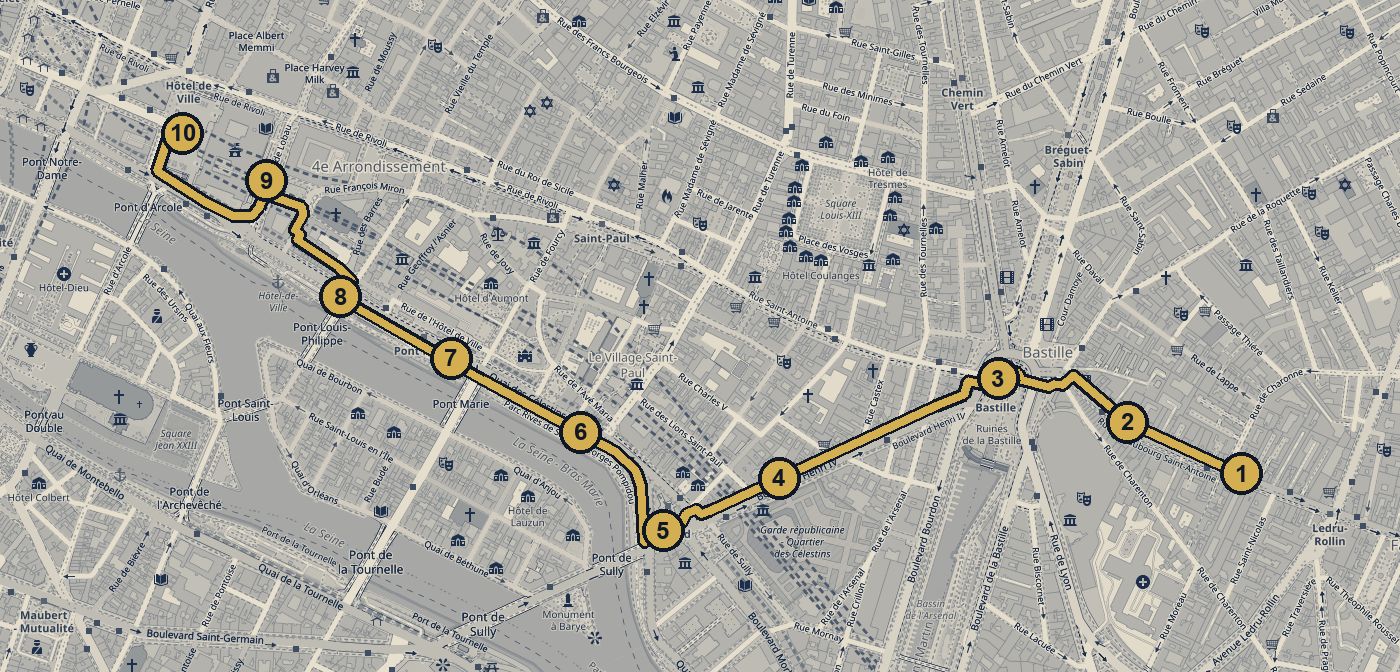
2.4 km on foot · See the starting point on a map · © OpenStreetMap
The stops
-
Before You Walk 0:35
Read the text
Listen. This morning, Paris is not at work.
I am a woodworker. I sand, glue, and assemble chests of drawers for people I will never meet. My hands smell of sawdust and hot glue. But today, the workshop is empty, and my stomach is as hollow as a box.
It is the 14th of July, 1789. Walk with me. I will show you the day the people of Paris stopped being afraid.
-
Faubourg Saint-Antoine 1:08
Read the text
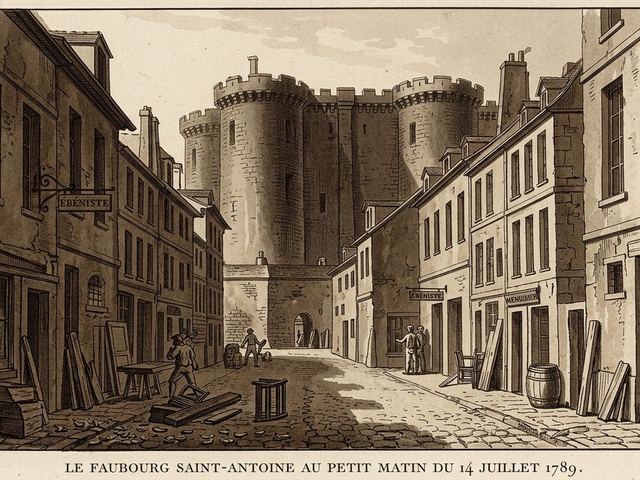
Here lies the Faubourg. The timber district. Thousands of hands: cabinetmakers, carpenters, turners, upholsterers. The poorest and proudest quarter of Paris.
Bread has doubled in price. Do you hear that? Doubled. A workman gives all he earns for bread, and yet there isn’t enough. Hunger gnaws at us here, a hunger that drives one mad.
And the day before yesterday, news spread from mouth to mouth: the king has dismissed Necker. The only minister who spoke for us. Cast out like a servant. Then it became clear. The king has summoned his regiments around Paris — foreign soldiers, cannons trained on the city. They don’t wish to protect us. They wish to subdue us.
Look at the men around me. Yesterday they planed boards. This morning they seek weapons. There’s an air of something I’ve never sensed before: we outnumber them. And we’ve nothing left to lose.
So we march. Westward. Towards the great black fortress that has always watched over us at the end of the faubourg. Come with me.
-
Artisan Courtyards 0:30
Read the text
Do you see those porches, those passageways that delve between the buildings? These are our courtyards. Behind them, hundreds of hidden workshops. Here, for centuries, we've had the right to work with wood without going through the guilds, without permission—it's the privilege of the Faubourg. That's why all the skilled poor of Paris are crammed into these streets. And a people who know how to handle a tool know how to wield a pike. Continue straight ahead, towards the square, over there at the end.
-
Place de la Bastille 1:43
Read the text
There it is. The Bastille.
Eight stone towers, walls thirty metres high, a moat as wide as a street. For as long as I can remember, it's been there, looming over our rooftops, dark, silent, dreadful. The king's prison. They say you vanish in there with just a simple letter, no trial, no return.
But listen closely, because people will spin you tales: we didn't come to free prisoners. There are only seven in there, seven forgotten old men. We've come for the gunpowder.
This morning, we were tens of thousands at Les Invalides. We seized thirty thousand rifles. Thirty thousand! But not a grain of gunpowder — they'd moved it all here, behind these walls. A rifle without powder is just a stick. So the whole city converged on the Bastille. To arm ourselves for battle.
We enter the outer courtyard. We negotiate with the governor, de Launay, up there on his towers. It's dragging on. And then — I still don't know who fired first — the drawbridge collapses, gunfire erupts. Our men fall on the cobblestones. We think we've been trapped, lured in to be slaughtered. Rage turns to madness.
And then something unexpected happens: the French Guards arrive. The king's soldiers. They switch to our side. With their cannons. They aim the bronze muzzles at the fortress gate.
By five o'clock, it's all over. De Launay surrenders. The bridge lowers. We enter the Bastille. We. The people. Into the impregnable.
-
Arsenal District 0:23
Read the text
To your left, the Arsenal. Remember that name. For centuries, this has been the place where the king's gunpowder and cannons are made and stored. You understand better now why this whole area is a powder keg—literally. We are walking on tonnes of gunpowder. And it is precisely gunpowder we thirst for this morning. Keep going down, to the riverbank.
-
Square Henri-Galli 0:56
Read the text
Approach. Touch these stones.
These are them. Genuine stones from the Bastille. Blocks from its foundations, unearthed and reassembled here.
Because the very day after the storming, we began to dismantle it. Stone by stone. Hundreds of men, myself included, tearing down the fortress by hand, under the watchful eyes of all Paris who came to witness. We didn't just want to defeat it. We wanted it gone. To erase from the Parisian skyline the silhouette that had made us bow our heads for four centuries.
A clever man cut the stones into miniature Bastilles and sold them across France as relics of freedom. The symbol of our fear became a keepsake to place on a mantelpiece.
Place your hand there. This is all that remains of Paris's greatest fear.
-
Along the Quays 0:15
Read the text
Turn along the river. The Seine, to your left, will accompany us to the end. Feel the procession gathering behind me — we're no longer a riot, we're a tide surging towards the heart of the city. Let yourself be carried by the movement.
-
The Quays (Procession) 0:51
Read the text
Walk. Don't stop. Tonight, all of Paris walks.
We are heading towards the Hôtel de Ville, and among us is de Launay. The governor. He's being dragged, pale, dishevelled, through the streets he lorded over from his towers just this morning. The crowd pushes him, hits him, hurls abuse. He knows what's coming. I walk, doing nothing to stop it, nothing to help him. I've seen our own fall at the gate. Pity, tonight, was left in the Bastille's ditch.
Feel the air shift. This morning, coming down from the Faubourg, we were a starving mob. Tonight, we are a force. Fear has changed sides. It's them now, behind their windows, watching us pass and trembling.
The river to your right has seen it all. Keep going.
-
Notre-Dame Over the Water 0:23
Read the text
Listen to the bells. They ring out across Paris. From one bridge to the next, from one bank to the other, the news travels faster than our steps: the Bastille has fallen. On the island opposite, at the windows, faces watch us pass by. Some are fearful. Many already cheer us on. Keep the river on your left, just a little longer.
-
Hôtel de Ville Emerges 0:29
Read the text
There. In front of you, that grand façade: l’Hôtel de Ville. The power of the city. This is where everything will unfold. Slow down. Breathe. What you are about to witness on this square marks both the end of the day and the beginning of a new world. Move forward to the centre of the forecourt.
-
Hôtel de Ville, Place de Grève 1:10
Read the text
Here we are. Place de Grève. The heart of the city's power.
This is where it ends — and where it begins.
De Launay dies on these steps. I won't tell you how. His head ends up on a pike, paraded around Paris. And with him falls Flesselles, the head of the merchants, who promised us weapons in the morning and sent us chasing after nothing. The people's anger does not forgive empty promises.
But look up at this building. Because while settling the morning's scores, something much greater is being born here. A new authority is establishing itself within these walls — the city is giving itself its own government, its Commune, its militia. Paris is governing itself.
Understand what has shifted in just one day. This morning, leaving the Faubourg, I was nothing. A starving woodworker, easy to starve, imprison, forget. Tonight, in this city, nothing happens without us.
The Bastille has fallen. But it is not a prison we have taken today.
It is fear. We've taken it, and we shall not give it back.
-
Epilogue 0:31
Read the text
You can sit down for a moment. Watch the people crossing the square, indifferent, hurried.
They walk across the Grève, unaware that it is here Paris learned not to bow its head. That beneath their calm steps, there was that July evening when a woodworker, like me, realised I had weight.
On the 14th of July, they’ll tell you it was a prison that fell. Remember it was mainly a people that rose up.
Thank you for walking with me.
Even better on site
With the app, each stop starts by itself as you reach it, phone in your pocket, even offline.