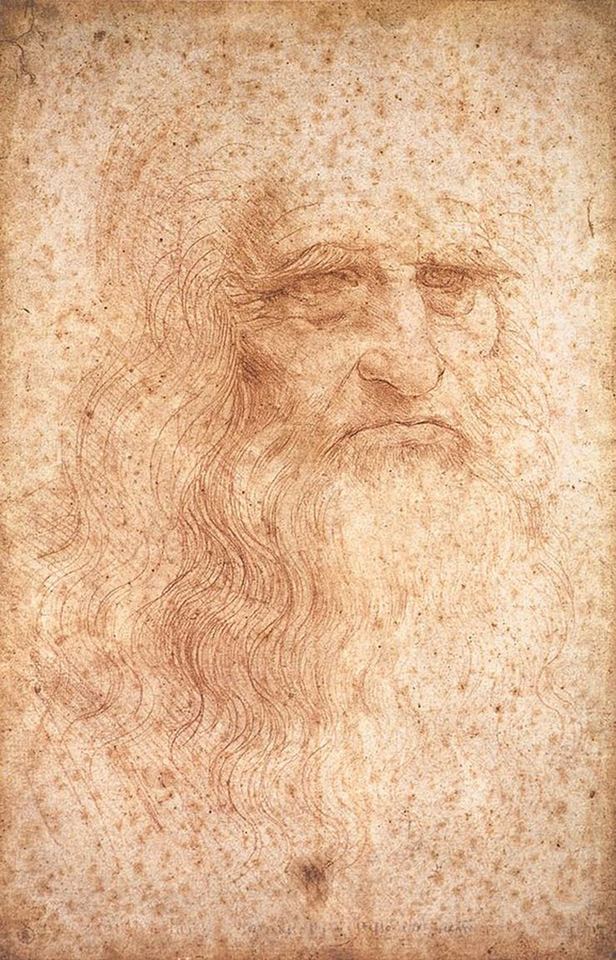
Vinci: Into the Mind of Leonardo
1504 · The Year of the Duel with Michelangelo
In 1504, the two greatest living artists are each given a wall in the same room. They must paint facing one another. They detest each other. Neither fresco survives today — and that is precisely the story.
14 min of listening
The route
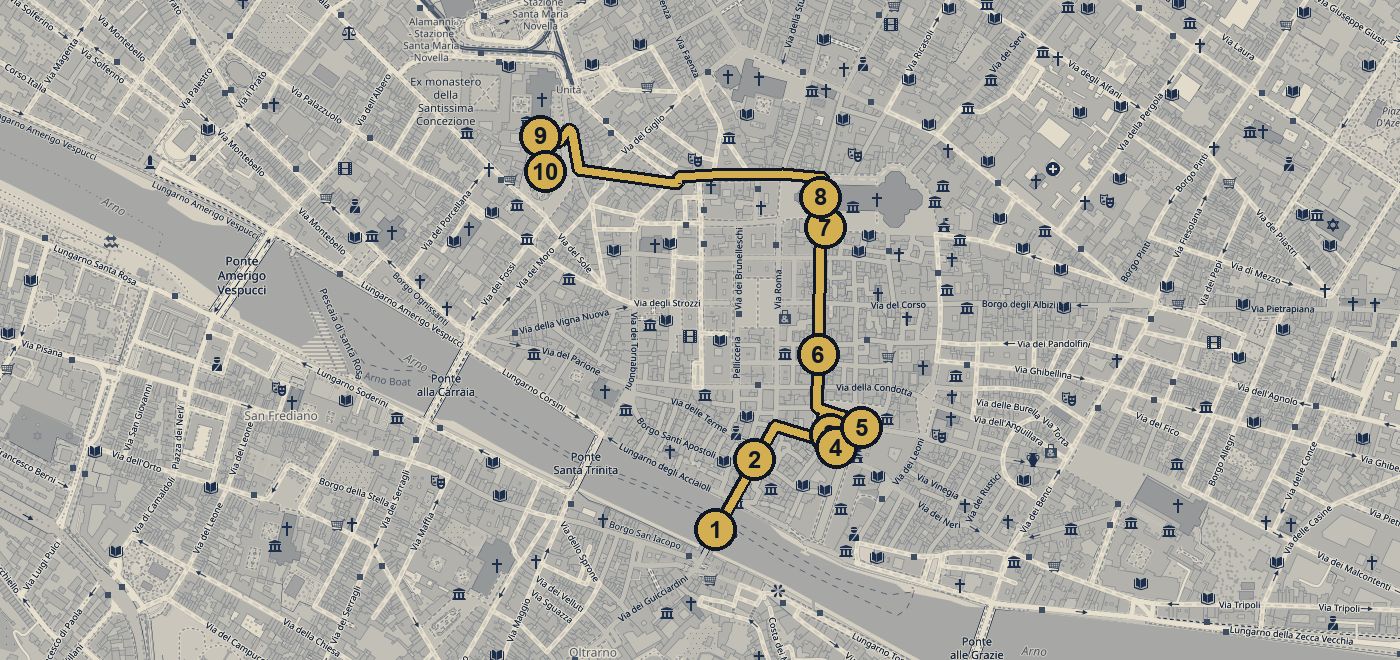
1.6 km on foot · See the starting point on a map · © OpenStreetMap
The stops
-
They Gave Me a Wall 1:30
Read the text
I've been given a wall.
It's September 1504.
Not a panel, not a canvas that can be moved. A seventeen-metre wall, in the grandest hall of the Republic. I'm fifty-two, and it's the most significant commission of my life.
And a few months ago, they gave the wall opposite to someone else.
A twenty-nine-year-old lad. He's just carved a four-and-a-half-metre giant out of a block of marble that nobody wanted. The whole city is buzzing about him.
We'll be painting face to face, in the same hall, for months. They say it's an honour.
I'll be honest with you, since you're walking with me: I've hardly finished anything I've been commissioned to do. A battle of horses in Milan, left in clay, riddled with arrows by French archers for sport. An adoration, abandoned. A bronze horse, never cast — the bronze went to make cannons.
People say I'm slow. It's not slowness.
It's that I always see something else. I start on a face, notice how the light turns on a cheek, wonder why, and spend three weeks on an ox's eye to understand. The painting waits. Often, it waits forever.
Come along. I'll show you the city, and I'll show you this wall.
-
Ponte Vecchio, Butchers' Bridge 1:46
Read the text
Can you smell it? No, you can't smell it.
This bridge, today, is the butchers' bridge. Dozens of stalls, and beneath each stall, a trapdoor. What isn't sold falls into the river. The offal, the blood, the heads. The Arno takes it all away, and in the summer, when it runs dry, it takes nothing.
In ninety years, a grand duke will drive them away to make room for goldsmiths, because he will have built a passage above and won't want to walk through that stench. You’ll see gold in those windows. I see carcasses.
I come here often, not for the meat.
I come because they throw the beasts away here. I buy what was about to be lost, and I take it back to the workshop to dissect it. A bull's heart. I spent weeks on a bull's heart, pouring wax into it to mould the cavities. I understood how the blood circulates through the valve. I can't tell anyone, because no one sees the point.
I don't eat meat, by the way. It amuses everyone. They've seen me buy caged birds at the market, open the cage, and watch them fly away. They find me eccentric. I prefer eccentric to what I truly think, which I keep to myself: one day, people will judge those who kill animals as they judge those who kill humans.
Well. It's not an opinion to share on a bridge.
-
Up Por Santa Maria 0:59
Read the text
We head back up towards the square.
This street is known for its silk. You can hear the looms behind the shutters — that regular clatter is the shuttle at work.
It was a husband from this street who commissioned a portrait of his wife from me, a year ago. A silk merchant, Francesco. His wife's name is Lisa.
I haven't finished it. Obviously. I doubt I will ever deliver it: I love it too much to part with it. I will carry it with me everywhere, all the way to France, until the end.
-
David, Installed in September 1:50
Read the text
Here it is.
Four and a half metres. It's been here since September, right in front of the palace door. It took four days to bring it from the cathedral workshop, suspended on a cart by ropes so it never touched the ground, and forty men to pull it.
No one wanted this block of marble. It had been lying around the yard for forty years. One sculptor had started on it, poorly, and abandoned it. Too tall, too thin, a gash right in the middle. All the city's masters looked at it and walked away.
He took it.
I must tell you something I dislike admitting. In January, the Signoria convened a commission to decide where to place it. I was part of it. Botticelli was there, Perugino, the Sangallos, about thirty of us.
I voted for the loggia, under the arches. Sheltered. Well-lit.
Many said I wanted to hide it. That I suggested the shadows so it would be less visible.
It's not untrue.
Do you know what bothers me about this thing? It's not that it's beautiful. It's that it's bare and simple. A man standing, a stone in his hand, and nothing else. No machinery, no perspective, no sfumato, no twenty years of research into light. A twenty-nine-year-old took a failed block and carved this, in three years, without ever pausing to understand anything else.
I've never finished a horse.
-
Loggia of the Landsknechts 0:40
Read the text
These arcades host the ceremonies of the Republic. Declarations are made here, honours received, and they offer shelter from the rain.
I find it perfect for a statue. A roof, three walls, with light streaming in from the front, unchanging throughout the day.
They didn't listen to me. They preferred the open square, the full sun, the rain, and the frost. Four centuries later, it will have to be brought inside.
-
The Wall They Gave Me 1:52
Read the text
Up there, behind those walls, lies a hall fifty metres long. The Hall of the Great Council. Five hundred men sit there.
On the east wall, me. On the west wall, him.
My subject: the Battle of Anghiari. A Florentine victory, sixty years ago. What I create is not a victory. It's four riders and four horses tangled around a banner, mouths agape, teeth bared, horses biting each other. You can't tell the men from the beasts. I've written in my notes that war is a bestial madness — pazzia bestialissima. That's what I'm painting.
And I'm going to fail.
I already know, in a way. I've refused the fresco — fresco demands swift painting on fresh plaster, without revisiting. I can't work like that. I wanted an oil technique, on a primed surface, so it could be reworked indefinitely.
To dry it, braziers will be set up. The lower part will set. The upper part, too far from the heat, will run. Months of work will slide down the wall as I watch.
I will abandon it in two years.
He won't even have started painting: the pope will call him back to Rome for a tomb, and he'll leave without a backward glance. Only drawings will remain of our two walls, and copies made by others from my sketch.
The greatest rivalry ever staged between two painters will produce no painting.
And one day, it will be painted over. Another will come, Vasari, and cover everything with his own battles. They're still searching beneath for my wall.
-
Orsanmichele, Guild Church 1:08
Read the text
This square mass is a church, and it used to be a grain market.
Look at the niches on the walls: each guild of the city placed its saint here, vying with their neighbours. The cloth, the wool, the bankers, the armourers.
In that one, there's a bronze group by Verrocchio, my master, whom I know well. Christ and Saint Thomas. It's my master who cast it, and I was in the workshop during that work.
Stop for a moment, because there's something I must tell you about this city, and I won't repeat it.
There are fifty thousand of us here. Fifty thousand. It's a small town.
And in this small town, in a hundred years: the man who raised the dome without scaffolding, the one who carved David, the one who painted Venus, my master Verrocchio, myself — and a chancellery secretary who's currently writing about power, words that will be read in five centuries.
We all know each other. We all trained in each other's workshops. And we almost all hate each other, which helps a great deal.
I don't know why it happened here. No one does.
Continue towards the baptistery.
-
The Dome, and How It Stands 1:42
Read the text
Look up. And ask the only question that matters: how does it stay up?
Forty-five metres across. Four million bricks. And not a single wooden support underneath during construction—because there isn't enough wood in Tuscany to brace that.
Brunelleschi built it without a central scaffold. Two domes, one inside the other, with a staircase in between. The bricks laid in a herringbone pattern, preventing them from slipping before the mortar set. He invented machines to hoist the materials, and he refused to explain how he planned to do it.
When asked to prove he knew how, he suggested a challenge: make an egg stand upright on a marble slab. Others tried. He took the egg and gently crushed one end. There were protests that anyone could do it with that trick. He replied, yes, and it would be the same with the dome if he explained how.
I was nineteen when my master placed the bronze orb atop it. Two tonnes, a hundred metres above ground. I was in the workshop; I saw the machines, the winches, the forges for welding the copper sheets.
I've kept notes on it all my life. There's a line in one of my notebooks that I often reread: remember the welding of the orb.
It's my oldest memory of the trade. A machine, high up, that works.
-
Baptistery Doors 1:21
Read the text
These gilded bronze doors were installed fifty years ago. Ghiberti spent twenty-seven years on them.
Ten panels, each with its own depth. He cheated: the figures at the back are almost flat, while those at the front emerge from the bronze. It feels like you're looking at an entire room within just two centimetres of thickness.
Step closer and examine the third panel from the top, on the left. Follow the tiled floor as it recedes. All the lines converge to a single point, behind.
That point doesn't exist. It’s a rule discovered here, in this city, eighty years ago, allowing depth to be captured on a flat surface.
Before, important people were painted larger than others. Now, they are painted further away.
It seems like a technical detail. But it’s a change of worlds: moving from art that shows what we know to art that shows what we see.
One day, my rival will call these the Gates of Paradise. It's the only thing we'll ever agree on.
-
Santa Maria Novella, My Workshop 1:56
Read the text
This is where I work. Not in the palace — here.
The monks have lent me a room, which they call the sala del Papa. It's large enough to lay out the cartone: the full-sized drawing, which will then be transferred onto the wall by pricking the outlines.
I come here every day. I've had a mobile scaffold installed, which I designed myself: it folds and unfolds to move up or down along the drawing.
And now, let me tell you the story of the street.
One day this year, I was passing near Santa Trinita. Some men were discussing a passage from Dante, and one of them asked me to explain it. I saw the young man approaching at the end of the street. So I said, politely: here comes Michelangelo, he will explain it to you.
I wanted to be courteous. I think. Maybe not.
He realised I was mocking him. And he replied, in front of everyone: "Explain it yourself, you who made a model of a horse to cast in bronze, who couldn't cast it, and who abandoned it out of shame."
Then he left without waiting. I blushed. It was written that I blushed.
He was right, that's the worst part. Seven years on that horse. Seven metres high, in clay, the largest ever attempted to be cast. I never succeeded in the casting. The bronze was turned into cannons when the war came, and the French archers used my horse for target practice.
This young man is twenty-nine and already knows exactly where I am vulnerable.
-
The Square in Front of the Church 1:13
Read the text
We stop here.
In two years’ time, I’ll leave the wall behind and head back to Milan. Then to Rome, and later to France, where a king will settle me in a manor and ask only for my conversation.
I’ll take three paintings with me. Including the one of the silk merchant’s wife, which I never delivered.
You know that painting. It’s in the Louvre, crowded with people all day long, and it has become the most viewed painting on earth.
I find it unfinished. I tinkered with it for sixteen years without ever handing it over.
This is what I want you to remember from this walk, and it’s not an artist’s advice, but an observation from a fifty-two-year-old man.
I’ve hardly completed anything. People have always criticised me for it, and they’re right.
But everything I started, I began by observing. Not by imagining: by observing, for a long time, things others found uninteresting — water swirling, a kite’s wing, the muscle beneath skin.
It's the only thing I know how to do, and anyone can do it.
You can start as you move on.
-
What I Haven't Finished 1:22
Read the text
One last thing, and then I'll leave you.
They'll say I was a universal genius. They'll make lists: painter, engineer, anatomist, musician, architect. They'll count the notebooks — seven thousand pages.
What they'll mention less is the number of completed works.
About twenty paintings. Perhaps fifteen that can truly be attributed to me. None of my flying machines ever took flight. The horse was never cast. The battle seeped away along the wall. The treatise on painting remained fragmented, and it was another who would assemble it after my death.
I don't know if that's a failure. I've pondered it often, and I haven't decided.
What I do know is that the boy across the way will finish what he starts. He'll live to eighty-nine, sculpt, paint an entire chapel ceiling, and build a dome larger than this one. He'll complete everything.
And yet.
When you arrived at this square earlier, you looked at the marble giant. Then you searched for my wall, which doesn't exist, in a room you didn't enter.
You've come to see what I didn't do.
I think that's quite alright.
Thank you for walking with me.
Even better on site
With the app, each stop starts by itself as you reach it, phone in your pocket, even offline.