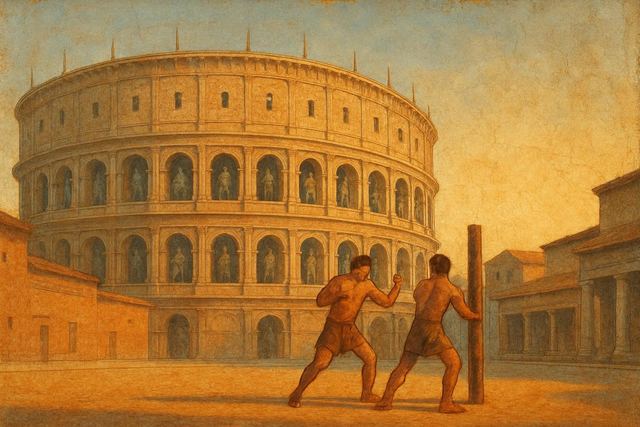
The Colosseum: Inside the Skin of a Gladiator
107 · The One Hundred and Twenty-Three Days of Trajan
We think we know the Colosseum. We climb it, photograph the stands, and leave. But the man who entered from below has never seen the stands from above. Follow him from the dormitory to the arena, then through the city that watches him die — and discover that it all began, two kilometres from here, as a funeral.
27 min of listening
The route
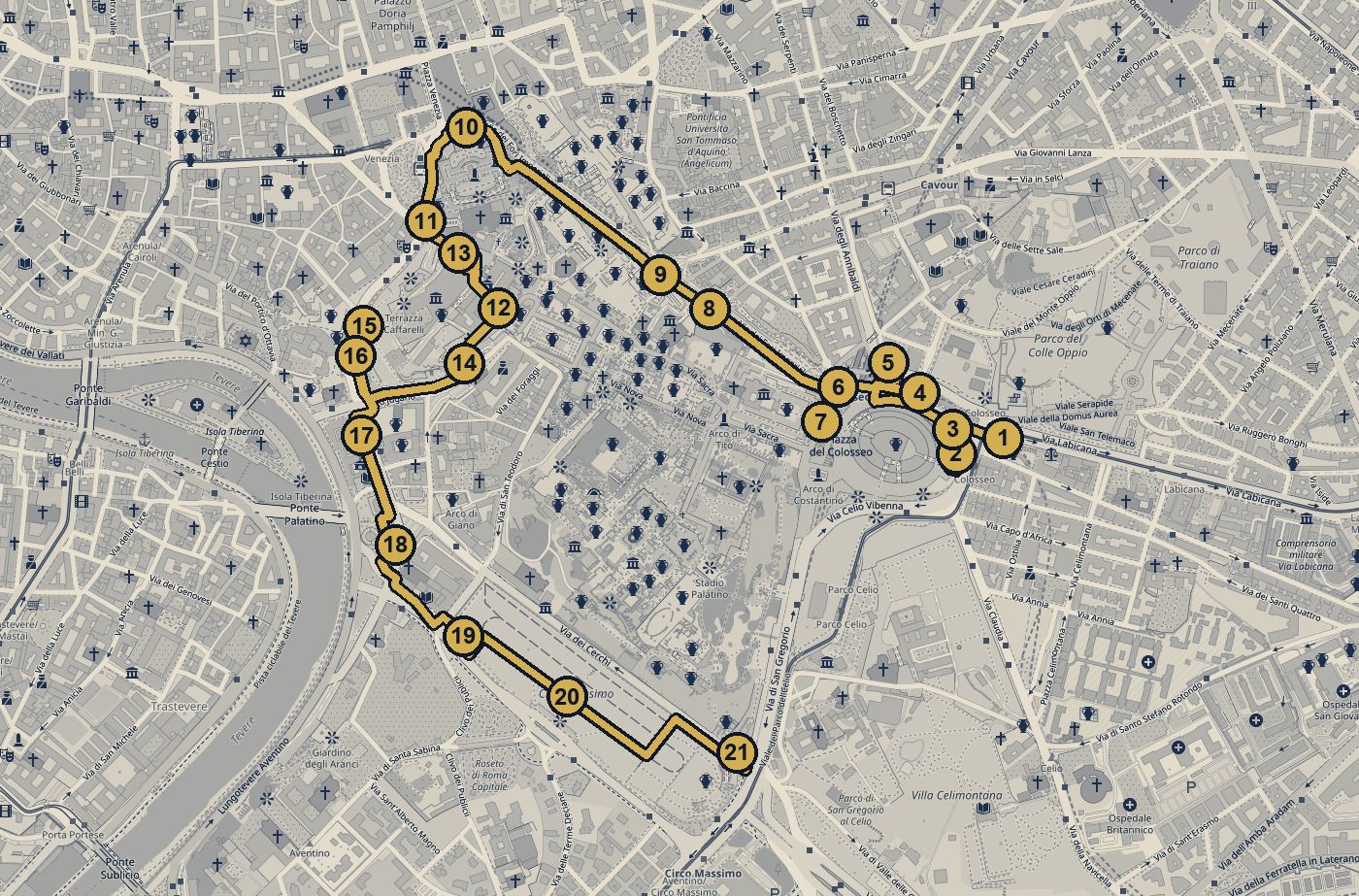
4.6 km on foot · See the starting point on a map · © OpenStreetMap
The stops
-
No choice in being here 1:30
Read the text
It is still night.
We are in the year 107, and the games have been going on for weeks.
I have been awake for a while. It’s not fear—people always think it’s fear. It’s the noise. Two thousand men sleep around me, and two thousand men, they breathe.
My name is... it doesn’t matter much anymore. On the posters painted on the city walls, they write another name, shorter, easier to shout. It’s that name forty thousand people will be screaming soon. Mine, the one my mother used to say, it’s only for me now, in the night, when I can't sleep.
I am twenty-six years old. I was sixteen when my father sold what he had left to sell, which was me. Seven years I have been fighting. Eleven times in the arena. Eleven times I walked out standing.
They call me murmillo. It is the name for those who carry the big shield and the crested helmet, the one they say is shaped like a fish. I’ve never seen this fish. I wear the helmet, I don’t look at it.
Today begins the ninety-first day. Trajan has promised one hundred and twenty-three days of games for his victory over the Dacians. One hundred and twenty-three. No one has ever done that. Ten thousand of us have passed into the sand since spring, and more remain.
Walk with me. I will show you the city as I see it: from below.
-
Ludus Magnus, the barracks 1:47
Read the text
Here we are. This is where I live.
The courtyard in the middle, that's our arena. It's a third of the size of the Colosseum — just enough to learn the distances. Around it, on two floors, are the cells. Mine measures three paces by four. I sleep there with a Thracian who snores and a Gaul who speaks to no one.
We're called barley-eaters. And it’s true. Barley, beans, barley, beans. The doctor says it puts fat under the skin, and fat bleeds a lot without doing much harm. A cut to the belly that gushes blood but hits nothing: the crowd's happy, and I'm still alive. They don't feed us to be pretty. They feed us to make our bleeding spectacular.
The care, on the other hand... You wouldn't believe it. We're treated better than senators. We're valuable. A man like me costs my master more than a mason earns in eight years. You don't let a racehorse die from a poorly stitched wound.
The doctores are veterans. Men who have won their wooden staff — the rudis, the staff of a freedman — and stayed because they know nothing else. One of them has only one ear left. He teaches the shield. He says the shield is eighty percent of the trade, and those who love their sword die by their third fight.
We train on the wooden stake. For hours. The same move. With a weapon twice as heavy as the real one, so the real one feels light.
And we've sworn an oath. All of us. Word for word: I consent to be burned, chained, beaten, and killed by the sword. We say it out loud, in front of the others. That day, we stop being a man as you understand it. We become something with a value, a trainer, a doctor, and a date.
-
The tunnel to the arena 0:40
Read the text
Here, beneath your feet, there's a passageway.
It stretches from the barracks all the way to beneath the arena. So that we don't have to cross the street. So that the city doesn’t see us before it’s time.
We descend in single file. It smells of damp earth and smoky torches. No one speaks. The Gaul, the one who never talks, starts murmuring in this passage, in his own language. I don’t understand a word. I think he’s saying names.
In this passage, I count my steps. Always the same number. It's foolish. But it keeps me occupied.
-
The Colosseum, east side 0:57
Read the text
Look up.
Eighty arches, fifty metres. Twenty thousand men and ten years to raise it from the ground—on Nero’s private lake. That's where you are: the bottom of a pleasure pond. Vespasian drained the lake and returned the hole to the people. The tyrant bathed here; now you sit here.
It’s white. Dazzling, almost unpleasant at midday. It screams wealth, it screams: we have plenty. That was exactly the message.
I rarely see this façade. I enter from below.
Only once were we made to march past it, armed, before the games. People leaned out of windows. A woman threw me a flower, and a man threw me a chicken bone. Both hit me.
-
Numbered arches 0:41
Read the text
Look at the arcades. They're numbered.
From one to seventy-six. The remaining four are reserved: the emperor, the Vestals, the magistrates, and us.
Each spectator receives a token — a tessera. On it: the arcade number, the level, the row, the seat. Fifty thousand people enter and sit without crossing paths. They say the building can be emptied in fifteen minutes.
I find it beautiful, and I find it terrifying. They've thought of everything. Including how to exit. Including how to remove us.
-
North facade, and what's beneath 2:29
Read the text
Beneath the sand, there's a city.
Two levels. Corridors, cages, workshops, wells. And thirty-two counterweight lifts, operated by men, hoisting animals directly into the arena through trapdoors. A lion appearing in the middle of the sand, emerging from nowhere: that's the effect. The crowd roars. The crowd loves it.
I wait below. In the dark, in the heat, with the noise above.
This is the worst moment. Not the fight — the waiting. Above my head, fifty thousand people stomp their feet on wood and stone, and it resonates, it makes the walls shake. You can hear the crowd change its mind. You hear a man die without seeing it: there's a scream, then another scream, different, shorter, and you know.
Next to me, there's the reserve sand. Tons of it. It's thrown after each fight, to cover. The word arena, actually, just means that: sand. This whole place is named after what’s used to hide the blood.
There's also a door you only go through once. The team calls it the door of the dead. Bodies are dragged there, checked to ensure they are indeed dead — an employee dressed as Mercury prods them with a heated iron, another, disguised as Charon, gives them a blow with a mallet. It's not cruelty. It's theatre, and it's administration.
I've never feared dying in the sand. I fear the mallet.
And then there's the smell, which no one ever talks about. The beast, to start with: the wild animals are penned just metres away, in the dark, for days. The vinegar that's splashed on the ground by the bucketful. The incense burned above to mask the rest. The three together, that's what I'll smell forever when I think of this place.
Sometimes we wait here for two hours. Some sleep — I swear some sleep. Me, I listen to the crowd and try to guess. A sharp cry that suddenly drops: someone has fallen. A silence — silence is the worst: a man raises his finger, and we await the decision.
I know my audience by sound before I've ever seen them.
-
Go around via north-west 0:37
Read the text
We carry on around.
Look up at the top of the wall. There are stone corbels, pierced, right at the top. They hold masts. And on the masts, a canopy: the velarium. A fabric roof unfurled over the stands when the sun beats down.
It's not workers who operate it. It's sailors, dispatched from the fleet at Misenum. Only they know how to handle a hundred ropes pulling in all the wrong directions. Rome has brought in the navy to provide some shade.
-
Colossus of Nero 2:08
Read the text
Here stands the giant.
Thirty-five metres of bronze. Towering over you, towering over everything. He holds a rudder and a cornucopia, sun rays encircle his head, and he gazes eastward.
Originally, this face belonged to Nero. He had himself cast as a god, nude, in the vestibule of his palace. After his downfall, they didn’t destroy the statue — too costly, too heavy, and above all: what a waste. They removed his head and replaced it with another. Now it’s Sol, the Sun. The same body, a different name. It was moved here with the help of twenty-four elephants.
I walk past it every time. Every time I think the same thing: they changed its head and no one said a word. The body, it doesn’t care.
And there’s this, which you might already know: in a few centuries, no one will call the amphitheatre by its name. They'll call it the Colosseum. Because of the colossus. The world's most famous building will bear the nickname of a vanished statue, of which not even the base will remain.
Right there, between the giant and the amphitheatre, a conical fountain seeps water across its entire surface — hence its name: the Meta Sudans, the sweating marker. It's here we come to wash after leaving the sand. The water is cold, it stings the cuts, and it’s the best moment of the day. Because if I’m washing, it means it’s over, and I’m standing.
We wash together, in silence. We look around to count who's here. It’s the only count that matters to us.
And there are those who come to wait for us. Common folk, mostly women, who buy our sweat. I’m not joking: it’s scraped off and sold, used in ointments. My master earns a regular income from it.
I’ll let you consider where that places a man. I'm locked up, fed barley, forbidden the courts — and what trickles from me is sold to ladies who wouldn’t dare speak to me.
-
Via dei Fori Imperiali 0:51
Read the text
We move away. Turn your back to the arena.
It's the first time since this morning that it's not looming behind me. It feels strange — like when you put down a load and still feel its weight.
In front of you, the valley opens up. This is the heart of Rome: the temples, the courts, the archives, the money. The city that decides.
I have no business there. A man of my standing doesn't walk up this way — we're moved in columns, at night, through the backstreets, so as not to be a nuisance. But today I walk with you, so I head up.
Look at the people ahead of us. They're off on their errands. Some will come to see me in two days, shouting my name, and now they pass by without recognising me. Without the helmet, I'm nobody.
It's a relief.
-
The Forum, from above 2:26
Read the text
Stop here and look down.
There's the Forum. It's small, isn't it? We always picture it larger. Two hundred metres by seventy, and within it, everything: the courts, the State treasury, the archives, the official calendar, the point from which distances across the Empire are measured.
Let me tell you what I see from here.
I see men who have never held a weapon deciding wars. I see the building where gold is kept — the Temple of Saturn, the one with the squat columns, there, on the right at the back. That's where the money comes from to pay for my games. I see the platform where speeches are made to the people. It's called the Rostra, because of the ship prows of enemy vessels nailed to its façade. They date from a battle four centuries ago. Rome forgets nothing of what it has won.
And I see something harder to express.
Those people down there, they love me. Truly. They know my painted name, they bet on me, they carve insults against my opponents. Some carry an oil lamp with my likeness. There are senators' wives who do very foolish things for a man like me.
And yet, I cannot enter there. I cannot testify in court. My body does not belong to me. When I die, I am not laid in the family tomb — gladiators have their own enclosures, kept apart.
They adore me and keep me outside. Both, completely, at the same time. It took me years to understand that it wasn't a contradiction. It's the trade. They adore what they can watch die.
There's a word for this in Latin, and it's dreadful. We are called infames. Without reputation. It's a legal status, not an insult: actors, charioteers, prostitutes, and us. Those who make a spectacle of their bodies.
And yet sons of good families have entered the arena, for money or glory, and their fathers had to seek dispensation from the emperor.
That's the state of things: what I do tarnishes enough to disgrace a noble, and fascinates enough for a noble to want to do it anyway.
-
Via Lata, the road north 0:57
Read the text
On this side the slope is built up from top to bottom: you don't climb here. You go around.
Look at the street ahead of you, to the north. Straight as a drawn line, for a full mile. That's the via Lata, the broad way. It crosses the Field of Mars, becomes the Flaminia, and doesn't stop until the sea, at Ariminum. Two hundred and ten miles.
All these roads start from the same point: a gilded bronze marker, set there by Augustus, at the far end of the Forum you were just looking down on. They say the distances of the Empire are engraved on it in letters of gold. I can't read. I was told, and I believed it.
I came in from the other end, by the Appia, the one that comes up from Capua. A hundred and thirty-two miles. I was sixteen, in a cart, and I counted the milestones one by one — there was nothing else to count.
-
Head up to the Capitol 0:39
Read the text
We climb a little further.
The hill before you is the smallest of the seven, yet it's the most significant. This is where the temple of the god who holds everything resides. This is where victorious generals conclude their triumph.
A triumph is a procession that winds its way up the Via Sacra with spoils, prisoners, and the victor riding in a chariot. Behind him, a slave holds a crown above his head and whispers in his ear throughout the journey, reminding him he is only a man.
I rather like this notion. No one bothers to remind us.
-
Capitol terrace 1:17
Read the text
From up here, you can see everything. It’s the best view of Rome, and it’s free. Always has been.
The massive building behind you is the Tabularium: the State archives. Every deed, every contract, in one building, above the Forum, for all to see. I’m in there. Somewhere. A bill of sale with a price and a date. That’s all the State knows of me.
And what struck me the first time I climbed up here wasn’t the beauty. It was the calm. Down below, in the arena, everything is loud and brief. Here, everything is slow. Deals take months, they build things to last centuries. These people have time.
A fight lasts between ten and fifteen minutes. Two or three fights a year, for maybe ten years. If you add up all the time I actually fought, my entire life put together, it’s less than three hours.
Three hours. And it’s for those three hours that they feed me, tend to me, lock me up, and shout my name.
The rest of the time — which is to say, my life — I’m hitting a wooden post.
-
Capitol square 0:42
Read the text
At the summit, there stands the Temple of Jupiter Optimus Maximus.
Enormous. Its roof covered with gilded bronze tiles. Visible from the entire city, and even from the sea on a clear day, or so they say.
Inside, the statue of the god has a face painted bright red, with minium. It is repainted for every major festival. It's a very old custom, and no one really knows why anymore.
The triumphant victor also paints his face red. For one day, he is the god. The next day, he becomes a man again, and the slave falls silent.
-
Tarpeian Rock 1:48
Read the text
Approach the edge. Not too close.
This is the Tarpeian Rock. Traitors and false witnesses are thrown from here. Hands bound, from the top, in front of witnesses.
It's not very high. Twenty-five metres, maybe less. They say it doesn't always kill on the first go, and I'd rather not dwell on it.
I always stop here when I pass by. Because it's the other way to die in public in Rome, and because the two couldn't be more different.
The one thrown from here is erased. No name is spoken. No body is retrieved. The family is not allowed to mourn in public. He dies of shame, and shame, in Rome, is contagious.
As for me, if I die tomorrow in the arena, they'll shout my name. Bets will be placed on who killed me. Someone might even carve an inscription: so many fights, so many victories, died at such an age. Those stones are everywhere, in the enclosures beyond the walls.
I'm not saying it's better. I'm saying I prefer it.
And there's something else people don't always understand. They think we die all the time. It's not true. We're too expensive for that. A defeated fighter can plead for mercy — he raises a finger, the organiser decides, the crowd advises. Most of the time, he gets it. Out of my eleven fights, I've lost twice. Twice I've raised the finger. Twice I've walked out alive.
A man sent back alive can fight again. A dead man has to be replaced, and the organiser then pays my master ten times the price. It's the fear of the bill that saves me, not pity. I'm quite content with that.
-
Descend to the river 1:14
Read the text
We head down towards the river.
It smells different down here. Fish, silt, livestock. This is the trade district, the port, the warehouses.
It's also Rome's oldest neighbourhood. Far older than the Forum, far older than the temple up there. Before there was a city, there was a ford, a herd, and people selling oxen by the water's edge.
Everything you've seen in the past hour — the columns, the marble, the statues — came later. The city began with cattle and a place to cross.
I like knowing that. Those who rise always end up forgetting we started at the bottom.
Something else, while we're here. Look at the animals' trough there, against the wall.
It's an auge. They water oxen here. And someone took the time to carve a lion's head into it, with the mane and open mouth, so the water flows through it.
An ox trough.
I show you because I think you wouldn't notice it. We don't notice it anymore either — it's everywhere. The bollards, the fountains, the thresholds, the handle of a knife: everything is crafted, even what no one comes to see.
I don't know if it's good or just pride. I know that's how we do it.
-
Theatre of Marcellus 1:03
Read the text
That one looks like the Colosseum. But it isn't: a semicircle, not an oval. It's a theatre.
I went there once. Masked men spoke in verse about a king who married his mother unknowingly, and upon learning this, gouged out his eyes. The audience wept. Merchants, family men, in tears for a king who never existed.
I thought to myself: no one bleeds. The blood is paint. They know it's false, yet they weep all the same.
In their world, everything is false and emotions are real. In mine, everything is real — the blood, the pain, my two fingers that no longer bend — and emotions are false. They don't cry for me. They shout. No one ever shouts for someone else; they shout for themselves.
I wanted to return to the theatre. We were never taken back again.
-
The old river port 0:50
Read the text
Here lies the river.
This is the route everything takes to arrive: grain from Egypt, oil from Spain, marble, livestock. And us. Many of us entered Rome through this very quay, deep in the hold.
The Gaul who doesn't speak arrived this way. He told me once, just once. Forty days at sea and on the river. He was eleven.
He isn't actually called the Gaul. He has a name, he told me, but I can't pronounce it. So, like everyone else, I call him the Gaul. It's been four years.
I feel guilty, walking here. I should try again.
-
Forum Boarium, cattle market 1:22
Read the text
Here we are. I've saved this one for last.
This square is called Mercato di Boario. A place without grandeur: livestock are sold here, and it smells as you’d expect.
This is where it all began.
Three hundred seventy years ago, a man named Brutus Pera died. His two sons wished to honour his funeral. So, in this square, before the funeral pyre, they set three pairs of men to fight.
Six men. Not for entertainment. To accompany the dead. It was a funeral rite, blood shed for the shadow of the father. It was called a munus — a duty.
And then families wanted to outdo their neighbours. Six men, then twenty, then a hundred. Then the magistrates realised that a watching crowd makes no demands. Then emperors erected a fifty-thousand-seat arena two kilometres from here.
I often think of those six. No one knows their names. They died for an old man they didn’t know, in a livestock square, and from that act came everything I am.
The word remains. We still call it a munus. A duty. When I'm sent into the arena, officially, I am performing a duty for someone.
I still don’t know for whom.
-
Via del Circo Massimo 0:54
Read the text
Just a few more steps. We walk along the base of the Palatine Hill.
Above you, on the hill, are the palaces. The Emperor resides there, and from his box, he can look directly into the valley where we are heading. A window, and the spectacle unfolds below.
Trajan is there almost every day at the moment. One hundred and twenty-three days of games require supervision.
I saw him once, from afar, in the arena. They make us raise our arms towards the box before we begin.
I couldn't tell you what he looks like. From that distance, with the helmet on, all you see is a pale blur and people around.
The man who decides whether I live is, to me, just a pale blur.
-
Circus Maximus 2:34
Read the text
Here it is. Take a good look and listen carefully, because this is the hardest thing I have to tell you.
This hollow is the Circus Maximus. Six hundred metres long. One hundred and fifty thousand seats. Three times the size of the Colosseum. It is the largest entertainment venue ever built in the world, and it serves only one purpose: to race horses.
Twelve chariots, seven laps, four stables — the Whites, the Reds, the Greens, the Blues. The entire city is divided by these four colours. People brawl in the streets over a race. An emperor once publicly sided with the Greens, and no one found it beneath him.
And now, the difficult part.
I am a gladiator. You've walked all day with me. You've seen my barracks, my underground quarters, my arena. You might think that I am what Rome is most famous for.
But I'm not. Not even close.
The true idols of this city are the charioteers. A few years ago, a certain Scorpus died. Twenty-seven years old. Two thousand and forty-eight victories. A poet wrote verses about him. Coins were minted. He earned in an afternoon what I am worth in total, at purchase.
And another, a Lusitanian, amassed a fortune in his lifetime that is still counted: thirty-five million sesterces. Enough to feed Rome.
We are counted in pairs. They are counted individually, with their name, their number of victories, and the names of their horses.
One hundred and fifty thousand people here. Fifty thousand over there. Do the maths. For every two Romans who come to watch me die, there are six who prefer to see horses run.
I am not bitter. It took time, but I am not anymore. It's even comforting, in the end, to know exactly where you stand.
And the reason is simple. A charioteer, you follow for fifteen years: you know his horses by name, you watch him grow old. He endures.
We do not. Two or three appearances a year, and one day we don't come back. You cannot love someone you see three times. You can only watch them.
The Romans do not love us. They consume us. The difference lies in one word: time.
-
The last lap marker 0:41
Read the text
There, at the end: the marker of the final lap.
The chariots round it as closely as they dare. This is where everything is decided, and where everything falls apart. A wheel grazes it, and the charioteer is thrown beneath the hooves — tethered by his reins, wrapped around his waist. He carries a knife at his belt to cut himself free. He never has the time.
They, too, in the end, are left unprotected.
Me, I've got a helmet, a shield, a referee, and the right to ask for mercy. He has a knife and seven laps.
-
What remains of a name 1:43
Read the text
It's over. You can sit on the embankment.
I want to tell you one last thing, and it's not sad, so don't look like that.
In the enclosures outside the walls, there are stones for us. I read one — well, it was read to me. A man had his name engraved on it, his type of fight, his number of victories, and a phrase at the end. The phrase said, roughly: I no longer drink, I no longer eat, I don't care, leave me be.
I quite like that man. He had a sense of humour.
Other stones are paid for by the wife. Because yes, some of us do marry, have children, buy our freedom, and end up as fencing masters. There's a stone where a woman wrote that she warns any man against marrying a gladiator. I quite like her too.
You, you'll leave shortly. You'll take the metro, or you'll go for dinner.
In nineteen centuries, what will remain of my world: an amphitheatre with its floor removed, two small temples saved by mistake, a lawn where the races once were, and a few hundred names carved in stone.
No statues for us. No History with a capital H. Just names, a tally of victories, and now and then a phrase of ill-temper.
That's fine by me.
Go on. The sun is setting and I must return. Tomorrow is the ninety-second day.
Thank you for walking with me.
Even better on site
With the app, each stop starts by itself as you reach it, phone in your pocket, even offline.