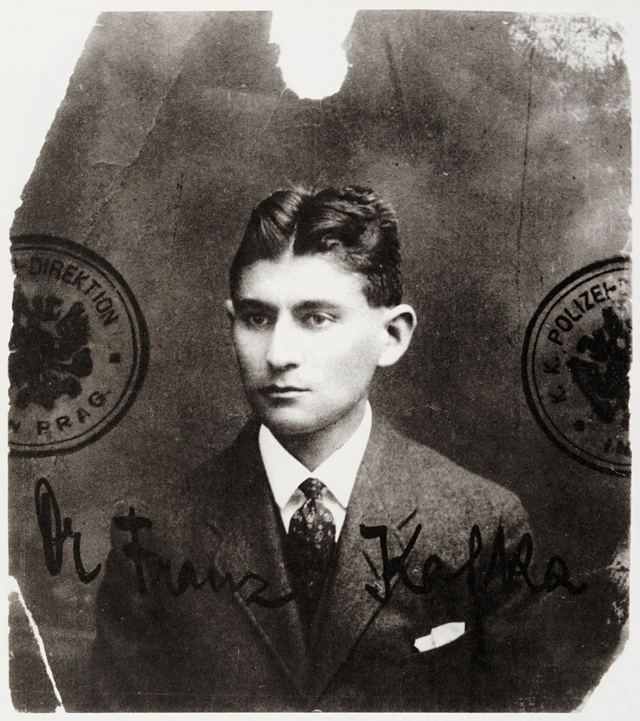
Kafka: In the Shoes of an Insurance Lawyer
1911 · Before He Was Kafka
In 1911, no one in Prague knows who Franz Kafka is. Neither does he. Follow a very polite, very tired office worker who crosses the same square every morning — and who will never know that his name will become an adjective.
14 min of listening
The route
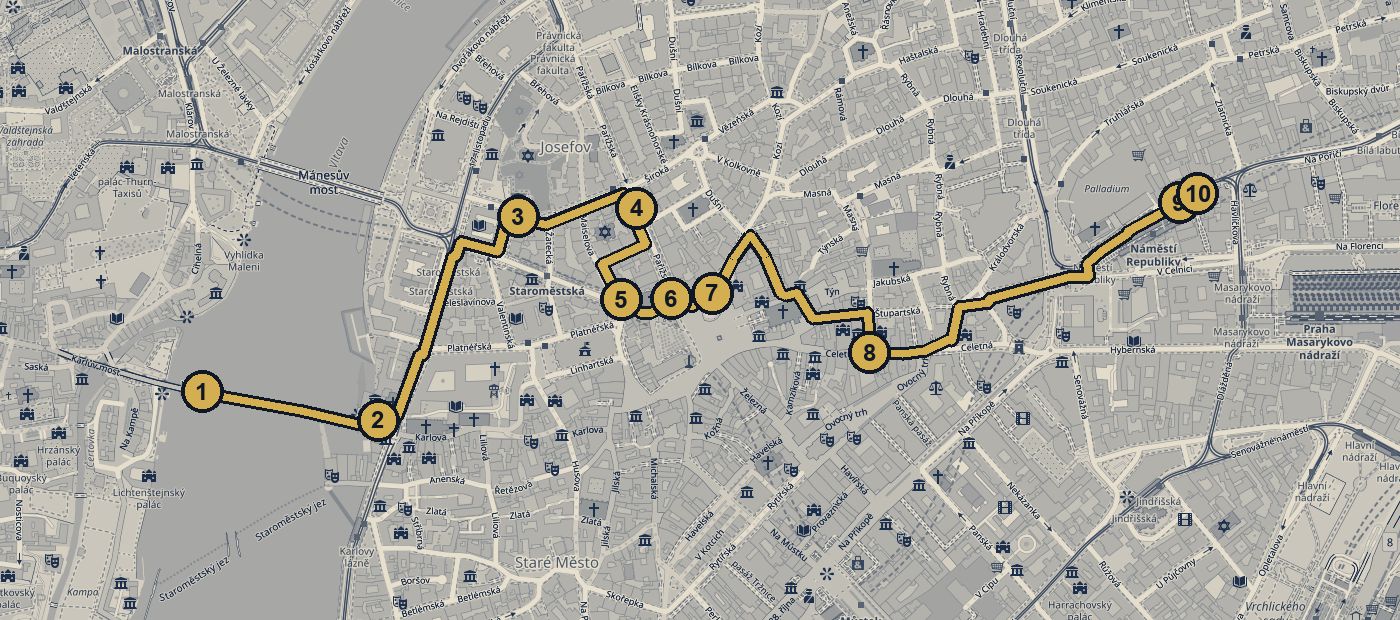
2.4 km on foot · See the starting point on a map · © OpenStreetMap
The stops
-
Quarter to seven 1:24
Read the text
It's quarter to seven, and I've been up for a while.
I don't sleep well. Haven't for years. The office opens at eight, closes at two, and that's why I'm there: it's a single-shift post. Six hours. The other firms do ten. I chose this one for the afternoons.
What do I do with my afternoons? I sleep. Then I walk. Then, around eleven at night, I sit and write until the light changes.
My name is Franz Kafka. It means nothing to you — it's 1911, and it means nothing to anyone. I've published a few short pieces in a journal. My father, who runs a novelty shop, hasn't read them.
Above his shop, there's a sign. A jackdaw. In Czech, a jackdaw is called kavka. That's our name, and it's our bird: a black, noisy corvid that nests in church towers.
I'm a Jew in a Catholic city, I speak German in a Czech city, and I'm a subject of the Emperor of Austria in a country that wishes it weren't. I don't fully belong to any of the three. Perhaps that's what makes me a writer, but it's not very comfortable day-to-day.
Walk with me. I take this route every day and have never had anyone to show it to.
-
Charles Bridge at dawn 1:37
Read the text
I come here when I can't sleep, which is often.
At this hour, there's no one around. The statues, however, stand firm. Thirty saints in blackened sandstone, lined up on both sides, staring into the void, their faces consumed by two centuries of coal smoke.
That one in the middle is John of Nepomuk. He was thrown from this bridge in 1393 by order of the king, for refusing to reveal the queen's confession. It's said that five stars appeared on the water where he sank.
What I focus on is the plaque beneath him. It's worn down to bare metal, because everyone touches it for luck. Thousands of hands on the same spot, over the centuries, until the design is erased.
I find it fitting. A gesture repeated long enough eventually destroys what it venerates.
I often think about that at the office.
I'm a lawyer. I handle cases for workers crippled by machines. This year, I wrote a report on woodworking planers. I had the severed fingers illustrated — the real ones, in various positions according to the cutting cylinder. And I suggested a cylindrical cutter that can't catch the hand.
I was praised. I was even promoted. I'm very good at this job that I despise, and that’s the kind of statement I can’t share with anyone.
-
Crusaders' Square 0:33
Read the text
We leave the bridge behind.
This little square is one of the ugliest yet most fascinating spots in Prague. Three styles clash here: the Gothic tower behind us, the Baroque church to the left, and the water just there.
I cross here every morning. Heading east, towards the office. Today, we'll take a detour — I want to show you where I come from.
-
The Old Jewish Cemetery 1:33
Read the text
Look over the wall.
Twelve thousand stones spread over a few thousand square metres. They lean against one another like a crowd squeezed together, with no room to fall.
This is not picturesque clutter. It's compulsion. For three centuries, the Jews of Prague were forbidden from expanding their cemetery by even a metre. So when it filled, they brought in more earth and started anew. Again and again.
In some places, there are twelve layers of the dead stacked atop each other, with ancient stones raised through the new soil to remain visible. That's why they lean: they've been shifted upwards, repeatedly, by the living who lacked space.
The last burial took place in 1787. Since then, nothing has been touched.
My grandfather was a butcher in a village, fifty kilometres away. He carried hundred-kilo sacks. My father recounts this every week at the table, always ending with the same phrase: and you, you can't do anything with your hands.
I've written a letter to my father. A hundred pages. I've never given it to him. It begins with: You recently asked me why I claim to be afraid of you.
Well — I will write it. In eight years. For now, it's just sentences in my head, every evening, as I come home.
-
Pařížská, the boulevard that swallowed the ghetto 1:33
Read the text
This avenue is new. It's less than ten years old.
Here, there was the ghetto. Alleyways, passages, courtyards, houses almost touching above the streets. Squalid, they said, and it was true.
Everything was razed between 1893 and now, and they built this: buildings with caryatids, a straight avenue, modelled after Paris.
I was born in those alleyways. My house was demolished when I was fourteen.
You must understand what this means in this city, otherwise you'll miss the point.
Prague doesn't demolish. That's its hallmark: wars bypassed it, fires spared it, and you're walking streets that haven't changed in six hundred years. Elsewhere, they rebuild; here, they repair.
There's just one exception, and you're standing in it.
The only district Prague has lost, it removed itself. Not an army: a city council, architects, a sanitation project.
And it was mine.
I'm not saying it was unjustified. People died of tuberculosis there. I'm saying I'm a man whose birthplace vanished while he lived there, in the city where nothing vanishes.
It leaves a mark. You'll find it in what I write, if you ever read it.
Continue towards the square.
-
The birthplace that no longer exists 1:33
Read the text
This is the spot. Or rather — it was.
I am born on 3rd July 1883 in a house that once stood at this corner. It was demolished in 1897. All that remains is the stone portal, preserved and reassembled in the new building. A door without its house.
I have no memory of the interior. I was two when we moved, and we moved eleven times. Eleven flats, all within a radius of three hundred metres. My entire life fits within a circle you can cross in four minutes.
I once wrote that this narrowness grips me, and if my teeth were strong enough, I would bite.
I am the eldest. I had two brothers, both dead before they reached two. Then three sisters — Elli, Valli, and Ottla, the last, the only one who understands me.
I will tell you what will happen to them, because you already know and pretending otherwise would be indecent. All three will die in the camps. Ottla will volunteer to accompany a transport of children from Theresienstadt in 1943. She knew where the transport was heading.
I will have been dead for nineteen years by then, of tuberculosis, in a sanatorium near Vienna. It is the only stroke of luck I ever had.
-
Enter the square 0:37
Read the text
We emerge onto the square. It's the largest in the Old Town, and it's the one I cross twice daily, for as long as I can remember.
To the right, the Town Hall and its clock. Ahead, the two black spires of Church of Our Lady before Týn.
My father ran a shop on this square. I spent my childhood afternoons here, watching the shop assistants being afraid of him.
-
Old Town Square, where he sleeps 1:49
Read the text
We live here. The corner building, on the top floor.
Four rooms for six people, plus the maid. My room overlooks the square — well, what we call my room is actually the passageway. To reach the living room, my parents walk through it. To go to bed, they walk back through it.
I write in there. At night, when they sleep, between two doors.
This isn't a complaint. It's a fact, and perhaps a necessary one. I need to write in a place I could lose at any moment.
Look at the clock over there. Every hour, the apostles pass by the two windows, Death turns its hourglass and pulls the cord, a rooster crows, and everything stops. People gather, wait ninety seconds, and applaud a machine from 1410.
It's said the city blinded the clockmaker so he could never replicate it elsewhere. It's false — the story was invented three centuries later, and we know the name of the real builder, Mikuláš of Kadaň.
I still prefer the legend. It speaks a truth about this city: here, people always believe a masterpiece must be paid for with mutilation.
And then, higher up, there's the Old-New Synagogue. They say that in its attic the Golem still sleeps: a man of clay crafted by a rabbi to protect the quarter, who became uncontrollable. They had to deactivate it by removing the word from its mouth.
A created being escaping its creator, in a city that builds machines to be applauded. I'll let you ponder why I think of that so often.
-
Celetná, the street to the east 0:52
Read the text
Here is my morning street. I walk it every day on my way to the office.
We've lived here too, at number 3. And at number 2. And elsewhere. I've told you before: eleven flats in the same neighbourhood.
Eleven. Always within five hundred metres of each other.
I'll be thirty in two years, and I've never slept more than a fifteen-minute walk from where I was born. I've tried leaving twice. Both times, I returned after a few weeks.
A friend once asked me why. I told him this little mother has claws.
He laughed. It wasn't a joke.
In a few minutes, we'll be at the office, and I'll become someone efficient again.
-
The office, Na Poříčí 1:48
Read the text
Here we are. The Accident Insurance Institute for the Kingdom of Bohemia.
Second floor. A window overlooking the street. A desk, files, and behind each file a man without a hand, without a leg, without an eye.
My job is to determine their worth and to classify the factories by risk category. The employers dispute it. The workers do not, because they do not know they can.
I am good at this. I’ve told you that, and it pains me to repeat it. I write clear reports, I rise through the ranks, and my superiors keep me on when I request sick leave that lasts for months.
And at two o'clock, I go home, and the other life begins.
This year, my father has decided something. My brother-in-law is starting an asbestos factory and needs money. My father is investing, on the condition that I become a partner and spend my afternoons overseeing it.
My afternoons. The only hours I have.
I did not say no. I never say no to my father — perhaps the central fact of my existence. I signed, I went, and I wrote in my journal sentences I will not reread in front of you.
Later, they will say I wrote administrative nightmares. Men summoned by institutions that never explain themselves, judged by rules that are never shown to them.
I invented nothing. I described my office.
-
The second-floor window 1:11
Read the text
Count the windows. Second floor, the third one from the left.
I stay here six hours a day, often gazing outside.
My job is to assess workplace accidents. Hands caught in machines, scaffolding falls, fingers severed by planers. I write reports to determine insurance claims.
I'm good at it. I've been promoted four times. No one in the office knows I write.
Tonight, I'll go home, sleep for two hours, walk, have dinner in silence, and around eleven, I'll sit down. Perhaps something will come. Often, there's nothing.
Next year, there will be something.
An entire night, in one go, from ten in the evening to six in the morning, without lifting the pen. A complete story.
I'll note in my journal that only in this way can one write, and that I'll never do it again.
I'll never do it again.
-
Burn everything 1:31
Read the text
One last thing.
Upon my death, I will leave two notes to my friend Max. The first one roughly reads: everything I leave behind, journals, manuscripts, letters, sketches, must be burned unread.
Max won’t do it.
He will publish The Trial, then The Castle, then America, then the journals, then the letters. He will devote his life to this task. He will be greatly criticised for it.
I’ll tell you what I think, or rather what might be thought in my place.
I chose as executor the only man in the world who, I knew perfectly well, wouldn’t obey me. Max had admired me for twenty years. He would transcribe my texts. He begged me to publish them.
Asking him to burn everything is not an instruction. It’s a way of not deciding.
I believe I wanted both things at once, right to the end, and I arranged for someone else to make the choice.
That is precisely the kind of man I was.
Right then. It’s past two o’clock. I’m heading home.
Thank you for walking with me.
Even better on site
With the app, each stop starts by itself as you reach it, phone in your pocket, even offline.