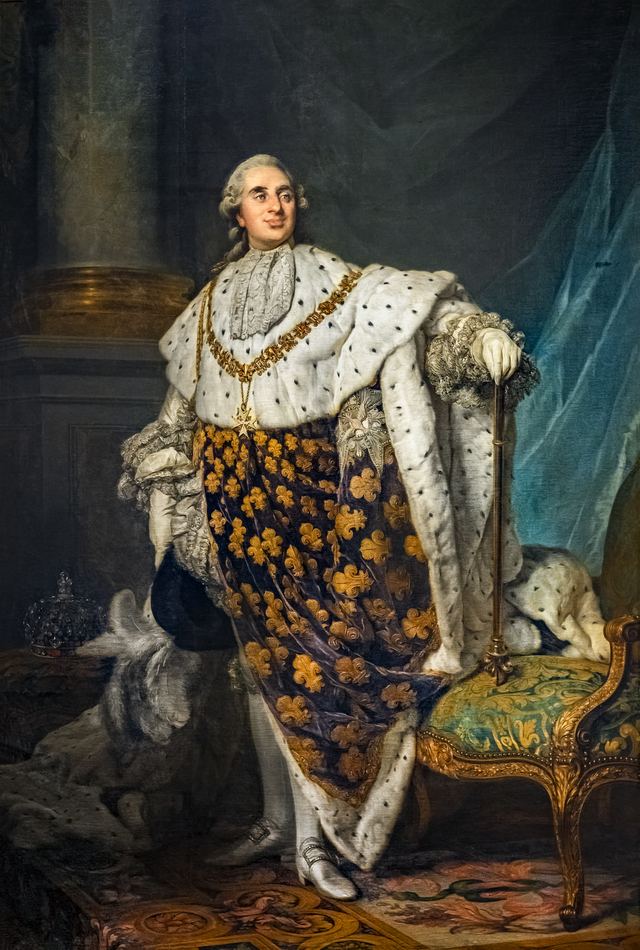
The Final Journey, in the Footsteps of Louis XVI
21 January 1793 · one hundred and ten minutes, from the Temple to the scaffold
He knows the time. He knows the place. Since last night, he knows everything — and he has four kilometres left to travel in a closed carriage, to the beat of drums, through a city ordered to shutter its windows.
23 min of listening
The route
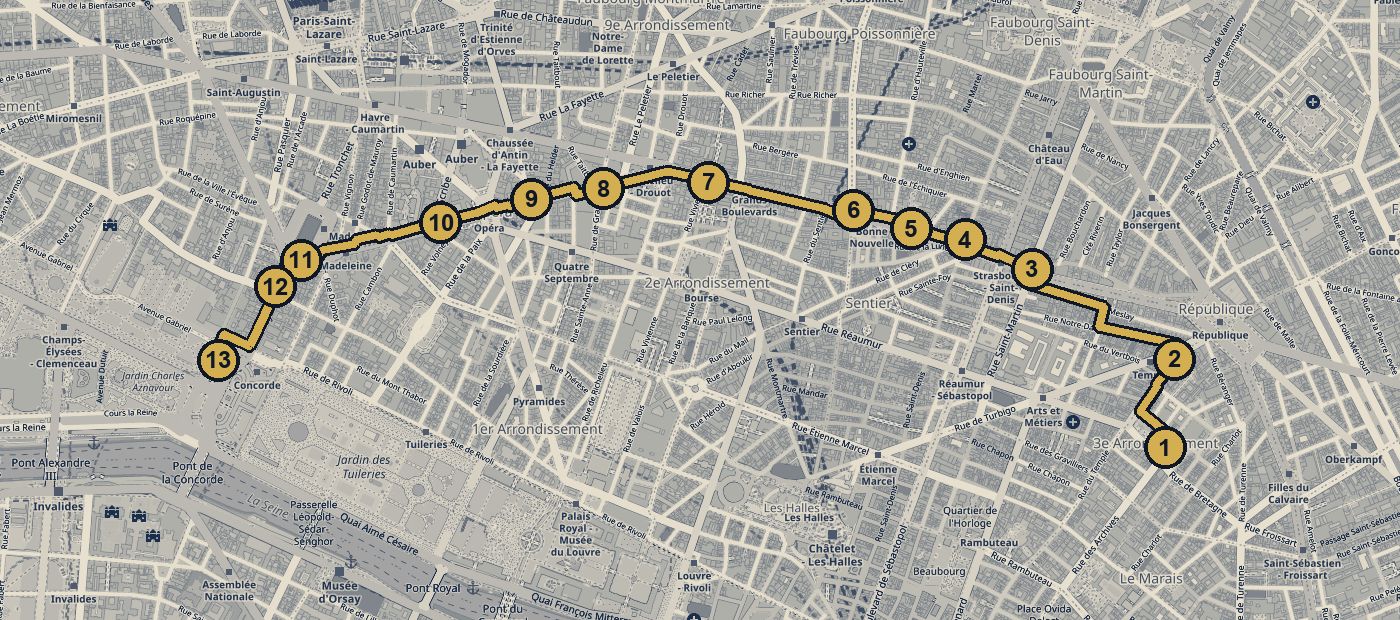
4.1 km on foot · See the starting point on a map · © OpenStreetMap
The stops
-
Five o'clock in the morning 2:42
Read the text
I rise at five o'clock. As I have done every day for twenty years, and for the last time.
It's Monday, 21st January 1793.
I should tell you who I am, otherwise you'll be following a condemned man, and that's not quite right.
My name is Louis, the sixteenth of that name. I am thirty-eight. For eighteen years, I reigned over the most populous country in Europe — twenty-eight million souls, while England has eight.
Two things I have done, which are rarely spoken of.
I abolished judicial torture. Before me, they would break a man's legs to make him confess; I signed to put an end to it.
And I funded the American War of Independence. Without my ships and my money, there would be no United States. I ruined my kingdom to help subjects rid themselves of their king — you'll appreciate the irony better than I.
For four months now, I am none of that. The court called me 'Louis Capet', after a tenth-century ancestor. They stripped me of even my name before taking away everything else.
It's often said that I was condemned by a single vote. It's untrue, and I'd prefer it not be repeated: three hundred and eighty-seven votes for death, three hundred and thirty-four against. It's no accident. It's a decision.
So this morning, they shaved me. I heard mass in my room — Abbé Edgeworth said it on a chest of drawers, with whatever could be found. I took communion. Then I waited.
Do you know what I did last night? I said farewell to my wife, my sister, my two children. Two hours. And as I left, I promised to see them again this morning, at eight o'clock.
I did not. I did not go back up.
It wasn't courage that I lacked. It was knowing what that second parting would be, and I had no right to impose it on them.
So I lied to my wife, the last time I spoke to her. It's what I regret most, and there isn't enough time left to regret it as I should.
Walk with me. It's four kilometres from here to the square. The carriage will take nearly two hours to make the journey.
Two hours. It's a long time, when you know.
-
Le Temple, the tower 2:11
Read the text
You are standing before what was once my final address.
A square tower, four turrets, walls three metres thick. It was built by the Templars in the 13th century — the Templars, an order of warrior monks returning from the Crusades, so wealthy that one of my ancestors had them burned to seize their gold. Justice has its ways of coming back.
We have been imprisoned here since 13th August 1792. Five months. My wife, my sister Élisabeth, my daughter Marie-Thérèse, fourteen years old, and my son Louis-Charles, seven years old.
Let me tell you what my days are like here, because no one ever seems to ask.
I rise at six o'clock. I teach my son: Latin, geography, a bit of arithmetic. I have him recite maps — I'm good at geography, perhaps the only thing I truly excel at. At noon we dine together. In the afternoon, I walk in the garden, forty laps, always the same number. In the evening, I read. I've read two hundred and fifty volumes in five months; I've counted them.
And I tinker. I've always tinkered.
At the Tuileries, I had a forge in the attic, a proper one, with a locksmith named Gamain. I made locks. They mocked me for it — the king filing iron while the kingdom crumbles. What they mention less is that Gamain went to show the Convention the iron cabinet we installed together in a wall, and the papers it contained. Those papers are one of the reasons I'm making this journey today.
The carriage is here. It's not a cart: it's a green, enclosed coach, the mayor of Paris's. Four of us get in — two gendarmes, the abbé, and myself.
Follow the street northwards. We ascend to the boulevard.
-
Ascend to the boulevard 1:18
Read the text
We head northward. Two hundred steps, and we'll reach the boulevard.
Listen. Or rather: hear nothing. That's what strikes me.
This morning, there are eighty thousand armed men in Paris. All shops are ordered to be closed. No one at the windows, no one on the balconies. A city of six hundred thousand inhabitants, and not a single cry.
Only the drums. They've been beating since we set out, and they won't stop. It's deliberate: if anyone wants to shout something, no one will hear.
I'll tell you what I'm doing inside, during all this. Because you're walking alongside a closed carriage, and you don't know what's happening inside.
There are four of us. Two gendarmes opposite me, who neither look at me nor speak. Abbé Edgeworth beside me, with his breviary.
We are reading the prayers for the dying. In a low voice, taking turns, one after the other.
They are lengthy. Thankfully: they will occupy the entire journey.
Continue towards the boulevard.
-
Porte Saint-Martin 1:39
Read the text
Look up. This stone arch, I'm quite familiar with it.
It was built in 1674 for my great-great-grandfather, Louis XIV, on the site of a gate from the fortifications that had just been demolished. Do you see the sculpted figures? They are his victories. A king of France would have triumphal arches erected in his own capital, and no one found it odd.
I, on the other hand, never had a single one built.
There's something I'd like to tell you about what people think they know of me.
It's said that on 14th July 1789, the day of the Bastille, I wrote just one word in my diary: 'Nothing'. And from this, they concluded that I understood nothing, that I was oblivious while France rose up.
This diary is a hunting journal. I note down the game. 'Nothing' means I didn't kill anything that day. I've written it dozens of times over twenty years, on perfectly ordinary days.
That doesn't make me a better king. But I've been judged a lot on a word that was about partridges.
Here's what is true, though: I'm slow. I always see both sides of a question, and while I weigh them, the opportunity slips by. A king who hesitates isn't a gentle king, he's a dangerous one — for others.
Continue straight ahead, due west. The boulevard will take us to the end.
-
Porte Saint-Denis 1:17
Read the text
Another arch. This one is two years older: 1672.
Look up: a stone obelisk adorned with sculpted arms, and two large reclining figures. That's the Rhine, and that's Holland. My ancestor had engraved upon it, in Latin, the words LUDOVICO MAGNO — ‘to Louis the Great’.
No one will engrave such words for me.
In fact, they took away my name. During the trial, they never called me king, nor Louis XVI. They called me Louis Capet.
Capet, that's the nickname of an ancestor who reigned eight hundred years ago. My family never bore it as a surname. They dredged it up to give me the civil status of an ordinary man, because one does not try a king — one can only try a citizen.
I don't hold it against them. It was logical. I needed to become someone before I could be condemned.
It felt strange the first time. They called me by a name that wasn't mine, and I answered.
We pass under the archway. Keep going straight ahead.
-
Bonne-Nouvelle, shutters closed 0:47
Read the text
Here, the boulevard rises slightly. We pass alongside the quartier of Bonne-Nouvelle.
All these houses have their shutters closed. That's the order that's been given, and I don't think it was necessary.
Behind these shutters, there are people who have loved me. There are others who hate me. And there are many, I believe, who no longer know, and who prefer not to look.
Perhaps this is the truth of this morning: France doesn't kill me with hatred. It kills me because it no longer knows what to do with me.
Continue on. To your right, the street descends toward the halles.
-
Faubourg Poissonnière 1:53
Read the text
Here we are at the crossroads of the faubourg Poissonnière. A street that ascends northwards, on your right.
It bears this name because this was the route the chasse-marée would take into Paris: carts laden with fish from Dieppe and Boulogne, travelling through the night to reach the markets before dawn. You could hear them coming from afar.
This faubourg is also home to the man awaiting me at the end of the road. His house is just a few hundred steps away. His name is Charles-Henri Sanson, fifty-three years old, and he is the executioner of Paris — or bourreau, if you prefer plain speaking.
This role is hereditary. He inherited it from his father, who in turn inherited it from his own. His sons will follow in the same path. A Sanson has no choice: he cannot leave the profession, cannot reside within Paris itself, and his family can only marry into other similar families. In shops, he doesn't take change directly; it's placed in a vinegar bowl.
I want you to know this because it is a fact, not a comfort.
A month from today, a newspaper will claim I struggled, that I had to be forcibly restrained. Sanson will take up his pen and write to the paper to refute this. He will say I endured everything 'with a composure and firmness that astonished us all.'
The man who kills me will be the only one, that month, to publicly defend my memory.
Continue straight ahead, always heading west.
-
Boulevard Montmartre 1:13
Read the text
Boulevard Montmartre. Ordinarily, it's the liveliest in Paris.
Cafés, theatres, print sellers, shell game players. People come here in the evening to see and be seen. My grandfather, they say, would come in disguise, to see Paris without being seen.
This morning, there's nothing. Shutters closed, chairs pulled in, and the trees are bare.
That's what makes this so strange: we are walking through an empty festival.
And I'll confess something that no one believes when I say it.
I do not know this city.
I ruled for eighteen years over this country from Versailles, twenty kilometres away. I came to Paris for ceremonies, in a carriage, through streets cleared beforehand. I've never walked here. I've never had a drink in one of these cafés.
This morning is the first time I cross Paris from one end to the other.
They are finally showing me my capital, and it is today.
Continue straight ahead.
-
Boulevard des Italiens 0:43
Read the text
Boulevard des Italiens. It takes its name recently, thanks to the nearby salle des Comédiens-Italiens.
I loved music. Not as one loves things to boast about — I found it soothing, and I had little rest.
My wife, however, truly loved it. She played the harp, she sang in tune. When she arrived from Vienna, she was fourteen, and I was fifteen. We were married without ever having been allowed to speak to each other alone.
She is still in the tower, right now. She is thirty-seven. She will live nine more months than I.
Carry on.
-
Carrefour de la Chaussée-d’Antin 0:57
Read the text
We cross a large intersection. To the right, a street ascends northwards: the chaussée d’Antin.
This is the district of new money. For the past twenty years, the fermiers généraux—those to whom the State sells the right to collect taxes, allowing them to keep the difference—have been commissioning grander hôtels particuliers (private mansions) than those of my dukes.
They bankrolled the Revolution before meeting their own demise. Nearly all will be guillotined next year, in the square I'm heading to.
It's something I've come to understand better over the past five months: a revolution doesn't stop at the king. It continues.
Continue straight ahead towards the west.
-
Les Capucines 1:19
Read the text
We're getting closer. The boulevard des Capucines, named after the convent on the left — a convent of nuns, closed last year along with all the others.
I have about twenty minutes left. Let me tell you what I do in the carriage, since no one can see.
I read. Abbé Edgeworth gave me his breviary — a book of prayers that priests carry with them — and we recite the psalms for the dying together. In a low voice, in Latin, for two hours, while the drums beat outside.
I don't look out the window much. I'm short-sighted. I read very well up close; ten paces away, I can't recognise a face. All my life, people have found me distant and aloof because I didn't greet those I couldn't see.
There you have it. You now know one true thing about me, and it's a ridiculous thing.
I think of my son. He's seven. Last night I made him swear never to seek vengeance for my death. He swore. He will die in two years, in this very tower, with no one knowing exactly how.
Take a left. We're heading down towards La Madeleine.
-
La Madeleine under construction 0:45
Read the text
On your right, that halted construction site.
It's a church my grandfather began thirty years ago. Built, demolished, started again twice, and since the Revolution, work has been at a standstill. There are only foundations and columns that support nothing.
It won't be completed for another half-century.
And behind, three hundred paces to the north, there's a small neighbourhood cemetery on rue d'Anjou. That's where I'll be taken shortly. Into a grave, with quicklime.
Head down the street to your left. That's rue Royale. The last one.
-
Rue Royale, the descent 1:26
Read the text
We descend.
This street was laid out by my grandfather to create the square below, which he built to his own glory. It was called place Louis-XV. His statue stood in the middle, on horseback, in bronze.
It was torn down last August. The pedestal remains, empty.
The square is now called place de la Révolution.
Three hundred steps. Walk slowly, please. It's all I can ask of you.
Here's what happens in the carriage during those three hundred steps.
The drums change. Until now they were in front and behind; now they're everywhere, thousands of them, and the sound comes up through the floor.
The priest stops reading. We were in the middle of a prayer. He doesn't finish it.
I look out the window and see my grandfather's empty pedestal. It's the last thing I recognise.
I think of a sentence I wrote in my will a month ago, and have been repeating since this morning, though I can hardly believe it: I forgive those who do this.
I wrote it because it needed to be written. This morning, I try to truly mean it.
I don't know if I succeed.
Look straight ahead.
-
Place de la Révolution 1:38
Read the text
Here we are.
Take a look around. You're standing in the midst of a vast square, and this morning, there are more people here than I've ever seen in my life.
The scaffold isn't in the centre. It's where you are, on the western side, between the entrance to the Champs-Élysées and the empty pedestal of my grandfather's statue.
It's just past ten fifteen. The journey took one hundred and ten minutes.
I step down from the carriage. I remove my coat myself. When they attempt to bind my hands, I refuse — it's the sole moment I stiffen. The abbé says a word, and I extend my hands.
I ascend. The steps are steep and I am heavy; I lean on his arm.
At the top, I approach the edge and ask for silence. I have time to say this:
"I die innocent of all the crimes imputed to me. I forgive the authors of my death. I pray God that the blood you are about to shed never falls upon France."
I won't have time to say more. A man on horseback shouts an order, and the drums resume.
That's it. This is where I leave you.
It will later be told that Abbé Edgeworth cried behind me: "Son of Saint Louis, ascend to heaven!" That's the phrase everyone will remember. Edgeworth wrote that he had no recollection of it.
What I heard last, myself, were the drums.
-
What remains 3:21
Read the text
Take a seat for a moment, if you like. Watch the cars as they turn.
Today, this square is the most congested junction in Paris. People dash across it to catch a green light, and almost none know what has happened where they tread.
Three things, to conclude.
The body was taken the very same day to the Madeleine Cemetery, on rue d'Anjou, six hundred metres to the north. In 1815, it was found and moved to Saint-Denis with that of his wife. Louis XVIII had a chapel built on the cemetery site which still stands: the Chapelle expiatoire, in square Louis-XVI. It can be visited, and it is almost empty.
The square changed names three times in thirty years: place Louis-XV, place de la Révolution, then place de la Concorde — the square of agreement, of reconciliation. It's a name given when one wants people to stop counting the dead.
And the obelisk, in the middle, comes from Egypt. It is three thousand three hundred years old. It was placed here in 1836 for a simple reason: something was needed at the centre of this square, and any French statue would have reignited old quarrels. A stone with no relation to us was chosen.
And then there is the fourth thing, the one I save for last, because it is difficult for me.
Look around you. These people crossing, laughing, waiting for someone.
None of them belongs to anyone.
In my lifetime, a man was born noble, priest, or nothing at all, and he died in the state he was born. He could be judged without knowing why. He could be tortured — I banned it, but I did not invent the idea that it needed banning.
Three years before that morning, an assembly wrote seventeen articles. Men are born and remain free and equal in rights. That text was translated worldwide. In 1948, when nations gathered to draft a universal declaration after a dreadful war, it was this text they began with.
And while I was being judged, scholars completed measuring the meridian to define a unit of length not dependent on any king. The metre. Look at what is written on signs, on bottles, on maps: almost the entire world now measures with it.
I did not want all this. I resisted, I retreated, I eventually fled, and it was this flight that cost me my head.
But I will not lie to you a second time today.
What emerged from those years is greater than me, and it is evident from here, in this square, at this hour, on the faces of people crossing it without anyone's permission.
You came for a beheaded king. I hope you leave with something else.
Thank you for walking with me.
Even better on site
With the app, each stop starts by itself as you reach it, phone in your pocket, even offline.