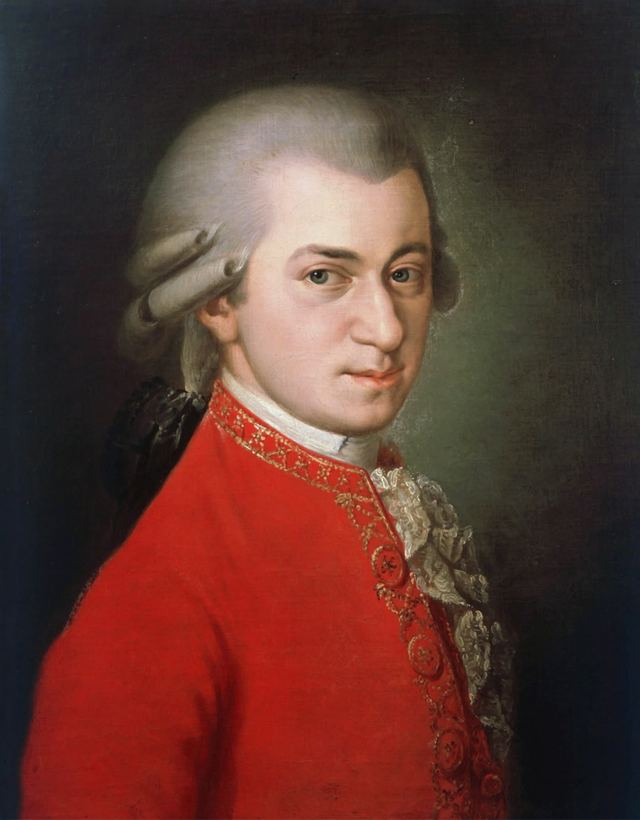
Mozart, in His Own Skin
1786 · The Year of The Marriage of Figaro, and the Peak He Doesn't See
His death is always told. His peak, never. In 1786, Mozart is thirty, wealthy, premieres The Marriage of Figaro, and has just buried his starling with a poem. It’s the year before — you know what comes next, he does not.
13 min of listening
The route
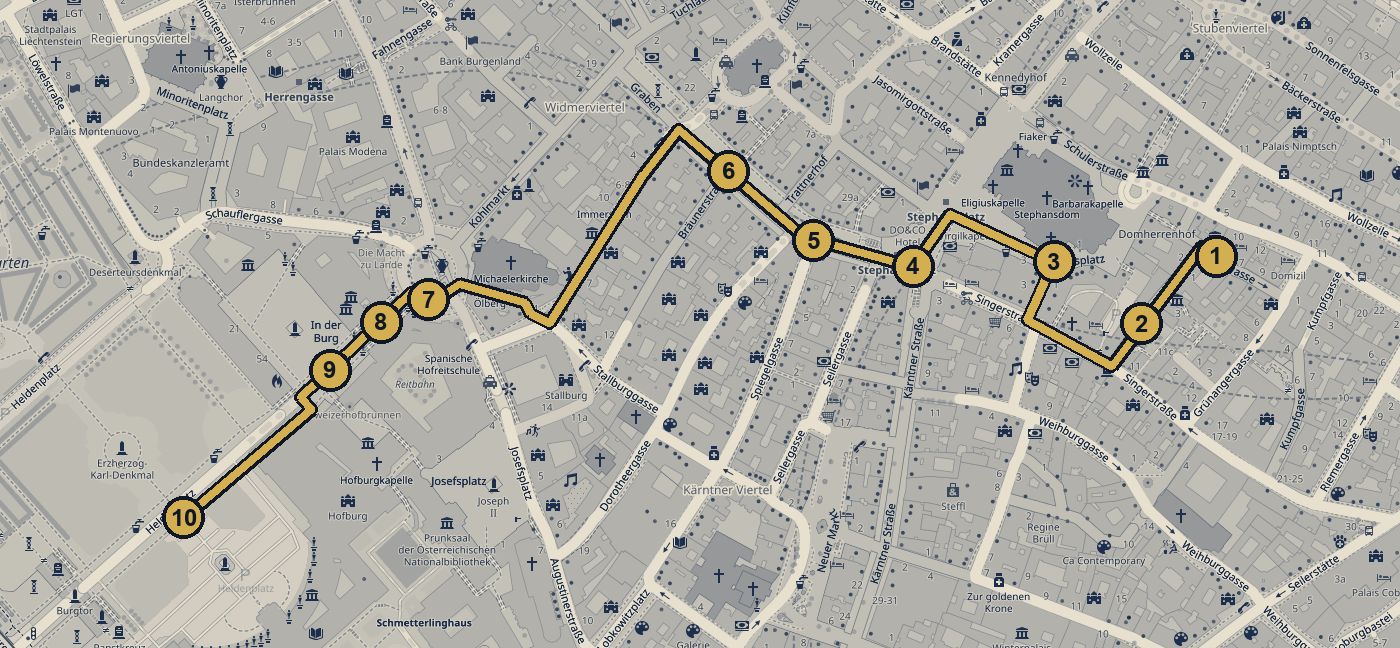
1.2 km on foot · See the starting point on a map · © OpenStreetMap
The stops
-
Four Rooms and a Billiard Table 1:25
Read the text
Let's step inside. Well — take a look at the façade, and I'll tell you about the rest.
The date is 1st May 1786.
First floor, four rooms, two cabinets, a kitchen. Four hundred and fifty florins a year. It's the most expensive rent I've ever paid, and it's the finest apartment I've ever had.
I'm thirty years old.
Let's clear up some misconceptions you might have about me right away, because they'll only get in the way as we walk.
I'm not poor. This year, I'm earning between three and four thousand florins. A court councillor earns fifteen hundred. I employ a maid, have a hairdresser who visits every morning, and there's a billiard table in the lounge.
I'm not persecuted by Salieri. We're rivals, which is quite different: we vie for the same commissions and greet each other in the street. He will conduct my music. He will later teach an insufferable young man from Bonn.
And I'm not a child prodigy turned tragic adult. I'm a swift-working craftsman who toils tirelessly, enjoys crude jokes, and has a dog, a starling, and a wife pregnant for the third time.
Come along. The weather's fine, and I need to call in at the copyist's.
-
Domgasse 5, the Elegant Apartment 1:42
Read the text
What I'm writing here, right now, is an opera about servants mocking their master.
Le Nozze di Figaro. The play by Beaumarchais from which it is adapted is banned throughout the empire. The emperor himself proscribed it two years ago: a valet triumphing over a count, in 1786, is not a comedy; it's an agenda.
My librettist, Da Ponte, went to see Joseph II and explained that he had removed the politics and kept the love. It was half true. The emperor said yes, probably because he loves music more than he fears the servants.
We premiere on the first of May, at the Burgtheater. Nine performances. It's not a triumph: Martín y Soler's opera, the same season, will have more than double that.
In Prague, however, it will be madness. I'll hear tales of my tunes being whistled in the streets, of dance orchestras playing nothing else. I'll go next winter, and I'll be received as no one has ever received me here.
I write standing up, often. And I write quickly — too quickly, they say. One day a nobleman asked me if I could explain how one composes. I replied that I knew nothing about it, that it just came, and the longest part was putting it on paper.
I wasn't being modest. It was accurate, and that's what sets me apart the most from others.
-
The Alley Behind the Cathedral 1:14
Read the text
I tread these few metres ten times a day.
Behind the cathedral lies the quarter of the canons, the scribes, and the booksellers. Everything I need is within two hundred paces.
Vienna's inner city fits within a handkerchief. Fifty thousand souls enclosed by ramparts that can be crossed on foot in a quarter of an hour. Everyone knows everyone, and everyone knows what their neighbour earns.
I tell you this because it explains everything else.
In such a city, one does not work alone. One works against.
There are about thirty men here who do the same job as I do, and we all know, down to the week, who received which commission, who was paid what, and at which countess's house we played on Tuesday.
Salieri is four streets away. Haydn comes when he can and we play together — he on the first violin, I on the viola.
It's not a republic of the arts. It's a village with wigs, and everyone keeps an eye on each other.
But let me tell you something: it's what drives me to work. Alone in a big city, I believe I would write nothing.
-
St. Stephen's, Where He Married 1:51
Read the text
Here stands the cathedral. Look at the roof before the spire: two hundred and thirty thousand glazed tiles, arranged in colourful zigzags, with the double-headed eagle.
I married here four years ago, in a side chapel. Constance was twenty, I was twenty-six. My father was absent: he disapproved, and his letter of approval arrived the next day.
We wept a great deal during the ceremony, both of us. The witnesses too. I wrote to my father that no one understood why, including ourselves.
This cathedral is also the place I will frequent most often without intending to. Six children. Four will die in infancy — the eldest at two months, two others within weeks. It's the norm of the century and it consoles nothing.
And it is here that my blessing will be said, in five years, on a December day. In the Chapel of the Crucifix, on the right as you enter.
They will tell you I was thrown into a pauper's grave, in the rain, with no one present. It will not be so.
Emperor Joseph reformed burials ten years ago: he finds them ruinous and unhygienic. Cloth sacks, graves for five to six bodies, no stone. For everyone. It is the law, and that is what will happen to me, as to fifteen thousand Viennese that year.
I will not be mistreated. I will be buried normally, and normal, in Vienna, in 1791, leaves no grave.
-
The Stock-im-Eisen 0:55
Read the text
This tree trunk wedged into the corner of the house, bristling with nails, has been here for centuries.
Every passing locksmith drove a nail into it for luck. There are thousands.
I have great affection for this object. It's utterly useless, yet everyone keeps adding to it, and no one knows why.
And what's even more intriguing: no one has ever removed it.
The house has been rebuilt around it. Twice. Each time, the trunk was left in the corner, and the masonry went up around it.
That's very Viennese. We keep things. We don't explain, we don't justify, we preserve — and three centuries later there's a piece of tree filled with nails in the wall of a modern building, right in the heart of a capital city.
-
The Graben and the Starling 1:29
Read the text
The Graben is where one parades. You stroll leisurely, greet others, observe who is conversing with whom.
And this is where I bought my bird.
On the 27th of May, 1784, at a shop on this very street. I paid thirty-four kreutzer.
Here's why. I stood before the cage, and the bird began to whistle. It whistled the theme of the final movement of my Piano Concerto in G major — the one I had just completed, which hadn't yet been performed publicly.
I recorded it in my account book. I jotted down the notes of my theme, and beneath them, what the bird made of it: it raised a G sharp where I had a G, and altered the rhythm slightly.
I added two words beside it: das war schön. It was beautiful.
A starling that corrects Mozart, and Mozart who admits the correction was better.
It died three weeks ago. I held a funeral in the garden, with people singing, and I wrote a poem for it. It begins with here lies a foolish bird.
I was much mocked for this, even at home. My father had just passed away, and here I was, burying a bird with ceremony.
I have no explanation. I think perhaps I had two griefs, and only one allowed me to weep.
-
The Plague Column 0:53
Read the text
This column gives thanks to God for halting the plague, a century ago.
Eighty thousand dead in Vienna in a single year. The emperor fled the city and promised a monument if he survived.
Look at the base: an old woman cast into a pit by an angel, the plague personified. Austrian Baroque never hints. It shows.
And we walk past it without a glance, every day, just a hundred metres from my home.
That's what I love about this city. It turned a century of terror into stone, right in the middle of its most beautiful street, and now people rest their shopping baskets against it as they catch their breath.
-
The Theatre That No Longer Exists 1:14
Read the text
Stop and search for a theatre. You won't find one.
It used to be here, against the palace wall. An ungraceful building, squashed in, poorly constructed — it was called the Burgtheater because it was stuck to the castle, not because it was beautiful.
This is where everything happened for me.
Die Entführung aus dem Serail, four years ago. Le Nozze di Figaro, this past first of May. And my concertos, which I played myself, at the piano, conducting from the keyboard, in front of an audience that had paid by subscription.
I gave up to three concerts a week in some seasons. That's where the money came from, not the operas.
And you see nothing.
It was demolished in 1888 to build a larger one, further away, with columns and a grand staircase. This is how cities treat places where something has happened: they replace them with buildings that look like they deserve for something to happen.
There is a plaque, somewhere on the wall. Look for it. It's small.
-
Pass Under the Hofburg 0:36
Read the text
We pass beneath the palace. This vaulted corridor connects the city to the emperor's residence.
I've come here often, never with the title I desired.
Joseph II is fond of me. He grants me eight hundred florins a year to compose ballroom dances — minuets, contredanses, for the carnival balls. It's well-paid and it's humiliating, and I take the money.
-
The Emperor's Court 1:35
Read the text
Here we are. The inner courtyard.
This is where I first performed, at the age of six. I was brought from Salzburg with my sister, and Empress Maria Theresa summoned us to her apartments.
They say I jumped onto her lap and kissed her. They also say I slipped on the floor, an archduchess my age helped me up, and I told her I would marry her.
Her name was Marie Antoinette. She's almost exactly my age.
I can't remember if it happened. I was six, and my father told this story at every dinner for twenty years—after a while, you can't tell if you remember the event or just the telling of it.
What I do know is what became of us. My father paraded us across Europe for ten years. Three and a half years of travelling non-stop. Munich, Paris, London, The Hague, Geneva, Rome. I spent more than a third of my childhood in carriages.
I fell ill everywhere. Smallpox in Olmütz, typhoid in The Hague, a fever in Munich that lasted for weeks.
People often said my father exploited me. It's too simple. He also taught me everything, and without him, I'd be an organist in a provincial town.
But I often think about what it does to a child, being presented. Not listened to: presented. Like something you show and then put back in its box.
-
The Glacis, Where Vienna Ends 1:06
Read the text
We end here, on the glacis.
The glacis is this wide stretch of bare land left all around the ramparts. Not a garden, not a district: a firing range. Nothing is allowed to grow here, nothing is to be built, so you can see the enemy coming from afar. Three hundred paces of emptiness, encircling the city.
Ahead, the walls. And beyond them, the countryside. Vienna ends here.
Fifty thousand people in a stone ring you can walk across in fifteen minutes.
In seventy years, all this will be dismantled to make way for a circular boulevard, and the city will swallow its suburbs. This void you're walking on will become the most beautiful avenue in Europe.
I have five years left. I don't know it. No one knows, especially not me, having just rented a flat for four hundred and fifty florins.
-
The Year Before 1:39
Read the text
You're going home, and you know what awaits me. I do not. That's the whole point of this walk.
So let me tell you what I know, on this last day of 1786 as we part ways.
I know that Figaro didn't achieve the triumph I had hoped for, but in Prague, they're going mad over it, and I'll see that in January. I know I'm thirty years old, that I've composed around five hundred pieces, and that the best one is probably yet to come.
I don't know that my father will die in May. I don't know that in eighteen months, I'll have to move to a cheaper district, nor that I'll write letters to borrow money from a fellow Freemason, letters you might read one day where I don't come off well.
I also don't know that a young man from Bonn will come to play something for me next year, and that people will later say I predicted he'd be talked about. They’ll likely have made up that quote, just like they'll make up the rest.
And I know nothing of 5th December 1791, nor of the canvas sack, nor of the grave with five slots.
What I'd like, if anyone were to ask me — and no one will — is for this year to be recounted rather than that one.
A thirty-year-old man with money, a wife, a billiard table, a dog, who buried his bird with a poem because he didn't know what else to do with his grief.
It was beautiful. Das war schön.
Thank you for walking with me.
Even better on site
With the app, each stop starts by itself as you reach it, phone in your pocket, even offline.